Understanding 18 minutes from table Matzos versus 18 minutes from kneading Matzos: Some Matzah bakeries offer two different types of Matzah, one being 18 minutes from the table and the second being 18 minutes from the kneading. The 18 minutes from kneading Matzas are traditionally more expensive. To the unaware, […]
Hagba-How many pages to show the congregation?
How many pages is one to show the congregation during Hagbah? One is to show [up to[1]] three columns of the Sefer Torah to the congregation upon performing Hagbah.[2] Possibly, one is to show exactly three columns [and not less or more].[3] Some Poskim[4] however rule that it is […]
How much is one to give for the Half Shekel?
* This article is an excerpt from the above Sefer Shop Now *As an Amazon Associate I earn from qualifying purchases. WhatsApp Facebook Twitter Telegram Sign up for Daily Distribution Sponsor an Episode How much is one to give for the Half Shekel?[1] One is to give three coins […]
Who may be given Matanos Laevyonim-Who is considered a pauper?
Who may be given Matanos Laevyonim-Who is considered a pauper? Some Poskim[1] rule that only those paupers who are extremely poor [and are beggars[2]] are considered Evyonim, and are to be given Matanos Laevyonim.[3] Other Poskim[4] rule that anyone who is poor, even not to the extreme mentioned above, is […]
The small letters of “Taf” “Shin” “Zayin” and their eerie connection
The small letters of “Taf” “Shin” “Zayin” It is customary to write in a smaller script three letters that are found within the names of the ten sons of Haman. These letters are: A small Taf in “Parshandasa”. A small Shin in “Parmashta” and a small Zayin in “Vayzasa”. It […]
Must women hear the reading of Parshas Zachor?
Must women hear the reading of Parshas Zachor? It is a Biblical obligation to hear Parshas Zachor.[1] Some Poskim[2] rule women are not obligated to hear Parshas Zachor.[3] Other Poskim[4] rule they are obligated just like men.[5] Practically the custom amongst many women is to treat the reading as an […]
Peeled eggs, onions and garlic left overnight-Part 1
Peeled eggs, onions and garlic left overnight:[1] One may not eat peeled garlic or a peeled onion or a peeled egg which stayed overnight.[2] [One who eats this food enters himself into danger.[3]] If the food was in a bag or container:[4] The above prohibition applies even if the peeled […]
Standing for Vanachnu Lo Neida in Tachanun
“Vanachnu Lo Neida” Standing at the end of Tachanun: In the paragraph of “Vanachnu Lo Neida” said in the end of Tachanun, some Poskim[1] rule it is proper to recite the words “Vanachnu Lo Neida” while sitting and then stand and recite the continuation from “Mah Naaseh”. Other Poskim[2] however […]
Reading another person’s mail, emails or WhatsApp/SMS messages
Reading another person’s mail or emails:[1] The famous Ashkenazi leader of the early middle ages, Rabbeinu Gershon Maor Hagoleh, instituted a Cherem [excommunication] against anyone who reads the mail of another person without permission. [This Cherem spread to all sects of Jewry, Sefaradim and Ashkenazim, and does not have a […]
Does placing a hand on one’s head suffice in place of a Yarmulke?
Does placing a hand on one’s head suffice in place of a Yarmulke? It is forbidden for men to sit, walk[1] or say a blessing[2] without a head covering. The following will discuss whether placing a hand on one’s hand is considered a valid head covering in a situation that […]
May a man and a group of women be alone together?
May a man and a group of women be alone together?[1] *Important note: There are several circumstances that can break a Yichud prohibition between a man and women, such as a Shomer, child, wife/husband in area. Pesach Pasuach to public, etc. The following law does not come to negate any […]
May a child be trusted to immerse a vessel?
May a child be trusted to immerse a vessel?[1] A child [who is below Bar/Bas Mitzvah] may not be trusted [alone] to immerse a vessel in the Mikveh.[2] However, if the child immerses the vessel in the presence [and under the supervision] of an adult [male or female above Bar/Bas […]
Educating one’s son to Daven Maariv and say the morning Shema
Are children obligated to recite the Shema?[1] Below age of Chinuch:[2] A child who is below the age of Chinuch is exempt from reciting Keiras Shema [by night and day].[3] Above age of Chinuch: A son who has reached the age of Chinuch is obligated in Shema [of both morning […]
Which blessing is said first-Shehechiyanu or the blessing over the fruit?[1] One who eats a new fruit which requires the recital of Shehechiyanu, is to first say the blessing of Shehechiyanu and only afterwards recite the blessing of Haeitz or Hadama.[2] [However, if one forgot and first said the blessing […]
The Mitzvah of a Chasan to rejoice with the Kallah after the wedding
Simcha-Rejoicing the Kallah:[1] A. The obligation of Simcha: The laws of Simcha refer to the obligation of the Chasan to rejoice his wife after the marriage takes place. This Mitzvah of rejoicing one’s wife includes spending time with her in festive meals, and not doing Melacha or going to one’s […]
Must one immerse electric appliances?
Must one immerse electric appliances?[1] Electrical appliances which are used to cook food, and come in direct contact with food, are obligated in immersion in a Mikveh with a blessing. This includes toasters[2], sandwich makers, water urns and the like. How to immerse and avoid damage: One is to immerse […]
Using someone’s Sefarim without permission
Using someone’s Sefarim without permission:[1] It is forbidden for one to learn from Sefarim that belong to one’s friend without his permission.[2] This applies even if one only plans to learn from it on a mere occasion.[3] This applies even if one is certain that no damage will occur to […]
Visiting grave after seven years of absence
Visiting grave after seven years of absence:[1] Some are accustomed that if one did not visit the grave of a parent within seven years then he may not do so any longer.[2] Others[3] are only careful after ten years of absence. Some Poskim[4] argue that one may visit a parent’s […]
Placing the Tefillin by the hairline-Part 1
Placing the Tefillin by the hairline:[1] The entire Tefillin must rest in the area where hair grows.[2] This means that [even] the bottom end of the Titura must rest on the area where the hair first begins to grow on the forehead.[3] [One who is not careful in this matter […]
May a gentile castrate an animal or human?
Is a gentile prohibited from castrating a human/animal as part of the Nohadite laws? This matter is disputed in the Talmud[1] and Poskim. Some Poskim[2] rule that gentiles are not prohibited against castrating. Other Poskim[3] rule that gentiles are prohibited against castrating. Practically, one is to be stringent like the […]
Making a Hefsek during Davening for the sake of a Mitzvah
Making a Hefsek during Davening for the sake of a Mitzvah: Hefsek for the sake of a Mitzvah:[1] It is forbidden to make an interval between Baruch Sheamar [and Yishtabach, and between Birchas Shema] and Shemoneh Esrei even for the sake of a Mitzvah [with exception to those cases […]
Bringing small children to Shul
Bringing small children to Shul: [It is a Mitzvah and obligation upon a parent to educate his child to go to Shul and participate in a Minyan, once they have reached the age of Chinuch.[1]] One is to teach his young[2] children and educate them to answer Amen. From the […]
Living and/or visiting Egypt
Living or visiting Egypt?[1] The Torah prohibits one from living in Mitzrayim in various places in scripture.[2] This prohibition is counted as one of the 365 negative commands.[3] Does the prohibition apply today? Some Poskim[4] however rule that the prohibition no longer applies today.[5] Other Poskim[6] however rule this prohibition […]
Men trimming and shaving their legs, arms, chest and other limbs
Men trimming/shaving their legs, arms, chest:[1] Trimming with scissor:[2] From the letter of the law, it is permitted for men to remove with a scissor the hair of the legs, arm, and chest. [Doing so does not transgress the prohibition of Beged Isha, or any other prohibition. However, removing hair […]
The proper blessing of a lemon
Blessing on lemons:[1] Lemons that are only mildly sour, and are thus edible, receive the blessing of Shehakol.[2] Lemons that are very sour to the point of inedibility, do not receive a blessing at all prior to consumption.[3] Lemon peel:[4] The peel of a lemon which is edible, receives the […]
The double portion of a Bechor received in inheritance
How much does a Bechor inherit?[1] A firstborn son, who is Halachically defined as a Bechor[2], inherits a double share from amongst certain[3] assets of his father. For example, if a father passed away leaving five sons, and one is a Halachically valid firstborn, the firstborn receives 1/3 [33%] of […]

The Hachansas Lecheder ceremony-Its source and significance
The Hachansas Lecheder ceremony-Its source and significance: One of the great milestones for a parent and child is the formal start of the child’s education in a Talmud Torah, where he will learn Torah and Mitzvos. The induction of the child into the Torah academy is escorted with various customs […]
If one did not hear some of the words in a blessing, is he Yotzei?
If one did not hear some of the words in a blessing, is he Yotzei?[1] One does not fulfill his obligation with any blessing, even if he answers Amen[2], unless he hears the [entire[3]] blessing from the beginning until the end. [Thus, if one did not hear the word Baruch […]
When does the fast begin?
When does the fast begin? All fast days [other than Tishe Be’av and Yom Kippur] begin by Alos Hashachar/daybreak.[1] There is general dispute amongst the Poskim as to the definition of Alos/daybreak according to Halacha. Some Poskim[2], and calenders, rule Alos Hashachar begins 72 minutes prior to sunrise. Other Poskim[3], […]
Child support-Until what age is one Halachically obligated to support his children?
Child support-Until what age is one Halachically obligated to support his children?[1] A person is [Rabbinically[2]] obligated to support his sons and daughters until the age of six years old.[3] From age six and onwards, he is to support them in accordance to the institution of the Sages, until they […]
Is Christianity considered Avoda Zarah?
Is Christianity considered Avoda Zarah? Christianity is considered Avoda Zara for a Jew, and carries all Avoda Zara related prohibitions.[1] However, some Poskim[2] rule that for gentiles, Christianity is considered Shituf and is not prohibited due to Avoda Zara.[3] Other Poskim[4] however rule that Christianity is considered like idolatry even […]
Custom of Nittle Nacht
Nittel Nacht A. What is Nittel? Nittel is a gentile Holiday celebrating the birth of Yoshke. On this day there is an extra abundance of impurity and a stronghold of Kelipa. For this reason, the Jews throughout the generations took various customs upon themselves which are followed until this day, […]
Saying “Avraham Zakein” after Hallel on Rosh Chodesh
Saying “Avraham Zakein” after Hallel:[1] Some[2] are accustomed to recite on Rosh Chodesh, after Hallel, the verse beginning “Veavraham Zakein” and “Zevadya[3] Yishmereini”.[4] [Practically, so is the Chabad custom.[5]] All this [Avraham Zakein and Zevadya Yishmereini] is recited a total of three times. [One is to say Avraham Zakein and […]
Forgot to say Ya’aleh Veyavo by Shacharis and remembered after Musaf
Forgot to say Ya’aleh Veyavo by Shacharis and remembered after Musaf: If one forgot to say Ya’aleh Veyavo by Shacharis, then he must repeat Shemoneh Esrei.[1] However, this only applies if one remembered prior to Davening Musaf. If, however, one already Davened Musaf and only then realized he had forgotten […]
Using real and edible olive oil versus fake or inedible olive oil for the Chanukah lighting
What olive oil should be used for the Chanukah lighting?[1] [From the letter of the law] all oils may be used for the Chanukah candles.[2] This applies even if the flame does not light well with the oil.[3] Nevertheless, it is a Mitzvah Min Hamuvchar to use olive oil.[4] If […]

Lighting Chanukah candles on Erev Shabbos
Lighting on Erev Shabbos:[1] When are the Chanukah candles lit? On Erev Shabbos, the Chanukah candles are lit prior to the Shabbos candles.[2] The candles are lit with a blessing even though they are being lit while still day.[3] [The earliest time one can begin to light the Chanukah […]
When may one extinguish the Chanukah candles?
When may one extinguish the Chanukah candles? Leaving home shortly after candle lighting, afraid that the unsupervised candles can lead G-d forbid to a fire? Many ask due to these reasons if they may extinguish the Chanukah candles after it has been lit for some time. This question is especially […]
Where in the home is one to light the Chanukah candles-By a window or by the doorpost?
Those who light inside their home-Should they light by the doorpost of one of the rooms or by the window?[1] A. The law of placing by the doorpost when lighting outside the home: Within a Tefach:[2] It is a Mitzvah for the candles to be placed within at least one […]
Kissing a child, relative, or friend in a Shul
Kissing in a Shul:[1] One is not to kiss his small children in Shul.[2] [This implies that it is however permitted to kiss older children, and other people, in Shul.[3] However, some Poskim[4] rule that in truth this applies to children of any age, and not specifically small children. Furthermore, […]
Using a Menorah for Chanukah candles-The Obligation; Material & shape
Must one use a Menorah, or can he simply stick candles on a table?[1] One fulfills his obligation even if he does not light the candles on a Menorah, but simply sticks a candle on the table.[2] However, some Poskim[3] rule that a Menorah is needed, and one does not […]
At what age is a man to get married?
* This article is an excerpt from the above Sefer Buy in Paperback or Kindle Buy on Apple Books Purchase on our website *As an Amazon Associate I earn from qualifying purchases. WhatsApp Facebook Twitter Telegram Sign up for Daily Distribution Sponsor an Episode Donatehttps://vimeo.com/245876789 At what age is a […]
Making a form of the human body in drawing or sculpture-Part 1
Making a form of the human body in drawing or sculpture:[1] It is forbidden to form a sculpture of the human body.[2] It is forbidden to make it even for purposes of mere beauty and decoration.[3] The prohibited form-Sculpture and protruding engraving versus drawing and internal engraving of above items:[4] […]
Yawning, burping and sneezing during Davening
Yawning and burping during Davening:[1] One may not burp[2] or yawn[3] during Shemoneh Esrei. If one willingly burps or yawns during Shemoneh Esrei he is from amongst the haughty individuals.[4] If one gets the urge to yawn [and is unable to control it[5]], then he is to place his hand […]
Must non-Mezonos cereals, such as cornflakes, be Bishul Yisrael and what is the status of Kellogs
Must non-Mezonos cereals, such as cornflakes, be Bishul Yisrael and what is the status of Kellogs? The general law: All foods that are cooked are subject to the laws of Bishul Akum, with exception to Mezonos products that are baked, which are subject to the laws of Pas Akum.[1] The […]
Must one cover the Tefillin Shel Yad with one’s sleeve
Covering the Tefillin Shel Yad:[1] There is no need to be particular to cover the Tefillin Shel Yad [i.e. hand Tefillin], such as with one’s sleeve, and one can choose to wear it either revealed [with his sleeves rolled up on top of the Shel Yad] or concealed [under a […]
What is the law if a Tzitzis string tore within the braid [i.e. Gdil], or beneath the braid [Gdil] by the hole?
What is the law if a Tzitzis string tore within the braid [i.e. Gdil], or beneath the braid [Gdil] by the hole?[1] If even one string tore from its root, it is invalid.[2] This means that if even one string tore near the hole, within the area that precedes the […]
Staring at another person-The prohibition and potential damage
May one stare at his friend?[1] It is forbidden to look into another person’s property [even if they are not present there] if there is possibility that the evil eye can damage their property. Thus, for example, one may stand over the field of his friend to stare at it […]
May women wear pants?
May women wear pants?[1] It is forbidden for women to wear pants. This applies even towards women pants that are made specifically for women and are not worn by men.[2] In the latter case it is disputed as to whether this prohibition is due to Lo Silbash or only due […]
Until what age may girls be present in the men’s side of the shul?
Until what age may girls be present in the men’s side of the shul? Some[1] write that one is to abstain girls from being present in the men’s section beginning from age three and onwards, even if they are dressed modestly. The Rebbe however writes that the prevalent custom [Maaseh […]
May one pay for an Aliyah, or other Kibud, using Maaser money?
May one pay for an Aliyah, or other Kibud, using Maaser money:[1] It is permitted to use Maaser money to pay for a Kibbud [i.e. Aliya, Pesicha, Hagba, etc] that was purchased in Shul, if one had intent to do so upon purchasing it.[2] If, however one did not have […]
With which foot is one to take three steps back after Shemoneh Esrei?
With which foot is one to take three steps back after Shemoneh Esrei?[1] When one takes three steps back after Shemoneh Esrei, he is to begin with his left foot.[2] A lefty:[3] One who his is left footed[4] is to begin with his right foot when he takes three steps […]
May a man listen to the recording of a woman singing, such as on a music player or radio?
May a man listen to the recording of a woman singing, such as on a music player or radio?[1] Some Poskim[2] rule it is permitted to hear a woman sing through a radio or recording if he does not know what she looks like.[3] Other Poskim[4] rule it is permitted […]
Understanding the words of Birchas Hamazon & the preferred language it is be said in
Understanding the words of Birchas Hamazon & the preferred language it is be said in:[1] Birchas Hamazon may be recited in any language [that he understands, as will be explained].[2] However, if one does not know the meaning of the words that he is saying in Birchas Hamazon, such as […]
Must a divorcee, or widow cover her hair?
Must a divorcee, or widow cover her hair? It is forbidden for a woman who was once married, such as a widow or divorcee, to walk in public with uncovered hair, just as is the law regarding a married woman.[1] [Some Poskim[2] rule that this obligation for a widow or […]
Using Maaser money to pay tuition of Torah education
Using Maaser money to pay tuition for school/Yeshiva/seminary or another Torah education:[1] The letter of the law:[2] If one cannot afford[3] to pay the tuition for Torah education from non-Maaser or non-Chomesh funds, it is permitted for him to use his Maaser or Chomesh money [which he separated], for the […]
Davening Mincha after sunset
Davening Mincha past sunset:[1] The prayer of Mincha may be recited until evening.[2] It is disputed amongst Poskim as to the definition of “evening.” Some Poskim[3] rule it is permitted [even initially[4]] to Daven Mincha past sunset, up until Tzeis Hakochavim.[5] Other Poskim[6] rule one may not Daven Mincha past […]
May a Gentile and one in process of conversion keep Shabbos
May a gentile keep Shabbos?[1] It is forbidden for a gentile to keep Shabbos. It is forbidden for him to keep Shabbos even on a weekday. A gentile who keeps Shabbos is liable. May a gentile who is in the process of conversion keep Shabbos? A gentile who is in […]
Borrowing a Sefer from a Shul
Borrowing a Shul’s Sefer:[1] An old edict that was founded in ancient congregations is that one may not remove a Tallis or Sefer from the Shul without asking permission from the owners. [This applies even if one can assume that the owner is not particular, nevertheless one must ask permission. […]
Stepping on egg shells
Stepping on egg shells: Many are accustomed to abstain from stepping on egg shells due to danger.[1] Accordingly, egg shells are not to be thrown in areas that people walk. There is a story dating back to the Rebbe Maharash regarding this matter.[2] _________________________________________________________________ [1] There is no known source […]
The obligation of sleeping in the Sukkah and why many [including Chabad Chassidim] are lenient
Sleeping in the Sukkah:[1] The obligation-Letter of the law: Part of the Mitzvah and [Biblical] obligation of dwelling in a Sukkah, is to sleep in the Sukkah throughout all seven days of Sukkos, both by day and night, just as one does in his home throughout the year.[2] It is […]
Entering pots into a Sukkah
Entering pots into a Sukkah:[1] [It is permitted to enter pots and pans of food into a Sukkah.[2]] Nonetheless, once the meal has been completed, one is to remove the pots, pans, and plates from the Sukkah, being that after their use they are considered repulsive [and it is belittling […]
May women and children help build a Sukkah
May women or children help build the Sukkah?[1] The building of a Sukkah is a fun activity, and great Mitzvah that many enjoy doing each year. Nonetheless, just as there are various laws associated with the validity of a Sukkah, so too regarding its construction. Only men are obligated in […]
A split Tiyomes-The law if the top middle leaf of a Lulav is split
The law of a split Tiyomes/Center leaf of the Lulav:[1] What is the Tiyomes? In Halacha, special attention is given to the Tiyomus of the Lulav, and the criteria it must fulfill for the Lulav to be Kosher.[2] The term Tiyomes comes from the word “twins”, and refers to the […]
Taking medicine on Yom Kippur
May one take medicine on Yom Kippur?[1] One who is currently sick: If one is bedridden, or feels ill/weak in his entire body, then he may swallow a tasteless or bitter pill [without water, as will be explained].[2] If the pill has a non-bitter taste, then he is to wrap […]
Washing hands after using the bathroom on Yom Kippur:
Washing hands after using the bathroom on Yom Kippur:[1] During non-prayer times:[2] If one urinated and used his hands to wipe away the drops of urine from his feet, or if he defecated and used his hands to clean the excrement, then he may wash his hands up until his […]
Are women obligated in shaking Lulav?
Are women obligated in shaking Lulav? Women are exempt from the Mitzvah of shaking Lulav.[1] Nevertheless, if they desire to shake Lulav, they may do so.[2] Practically, women have accepted upon themselves the Mitzvah shaking of Lulav as an obligation.[3] [Accordingly, women are to be particular to shake Lulav each […]
Leaving a light on in the marital bedroom on Yom Kippur
Leaving a light on in the bed room of married couples:[1] If a couple is leaving a light on in their house [on the night of Yom Kippur], then they are required to also leave a light on in their bedroom.[2] This applies both in areas that are accustomed to […]
One who forgot to say Hamelech Hamishpat
One who forgot to say Hamelech Hamishpat:[1] In Shemoneh Esrei of Aseres Yimei Teshuvah the tenth blessing of Hashiva Shofteinu concludes with the words “Hamelech Hamishpat” in place of “Melech Ohave Tzedaka Umishpat”.[2] [This emphasizes that Hashem is the King that is currently in judgment at this time.[3]] If one […]
Speaking in-between blows of Shacharis and Musaf
Not to talk of irrelevant matters until after Musaf:[1] One must beware not to talk of irrelevant matters between the Tekios Meyushav [which is the first set of blows that is sounded after Kerias Hatorah] and the Tekios Meumad [which is the second set of blows in Musaf].[2] One […]

Preparing on the 1st day for the 2nd day of Yom Tov or Shabbos
Preparing on the 1st day of Yom Tov on behalf of the 2nd day of Yom Tov or Shabbos: Preparing on 1st day on behalf of 2nd day in Chutz Laaretz:[1] It is forbidden to do anything on the 1st day of Yom Tov on behalf of the next day, […]
Hataras Nedarim on Erev Rosh Hashana-Q&A
Hataras Nedarim: *For a full digest on the laws and customs of Hataras Nedarim both on Erev Rosh Hashanah and throughout the year, please refer to the “Supplement on Hataras Nedarim” provided in the back of the Sefer. It is customary to perform Hataras Nedarim on Erev Rosh Hashanah.[1] This […]
How much money is the Kesuba worth?
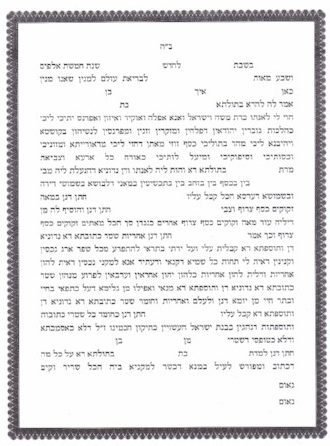
How much money is the Kesuba worth? Introduction: A Kesuba is similar to a loan document or check, which obligates the husband, or his estate, to pay a certain sum of money to his wife. The Kesuba can only be actualized in the event of death of the husband or […]
Must Twizzlers and other candies be Bishul Yisrael?
Must Twizzlers and other candies be Bishul Yisrael? The recipe: The Twizzler candy produced by Hershey corporation contains as main ingredients: Corn syrup, wheat flour [25%], sugar, and cornstarch. These ingredients are cooked together for several hours and then cooled to form the Twizzler candy. The general law: All foods […]
What is the correct blessing to say over Twizzlers
Blessing on Twizzlers: The ingredients of Twizzlers: The Twizzler candy produced by Hershey corporation contains as main ingredients: Corn syrup, wheat flour, sugar, and cornstarch. As per the information received from the OU, who supervises the Kashrus of the product, the Twizzler contains 25% wheat flour. The general law by […]
How many people must eat to make a Zimun of ten with Elokeinu
How many people must eat to make a Zimun of ten with Elokeinu?[1] In order to be obligated/allowed to make a Zimun of ten people with the saying of Elokeinu, one needs to have at least seven people who have eaten [a Kezayis of] bread, and another three people who […]
Blessing one’s children on Friday night
Blessing children on Friday night: It is an old age custom for parents and Rabbis to bless their children and students with Birchas Kohanim on Friday night.[1] Doing so does not transgress the prohibition[2] against a non-Kohen reciting Birchas Kohanim[3], although it is forbidden for the person to raise his […]
Must a Kallah cover her hair during the Chuppah/wedding
Must a Kallah cover her hair during the Chuppah/wedding:[1] The opinions: A woman is required to cover her hair from the time she is married and onwards.[2] It is debated amongst Poskim as to the exact definition of marriage in this regard; Does it refer to the Kiddushin, Chuppah, the […]
Visiting the Temple Mount-Part 2
May one visit the Temple Mount?[1] The Temple area contains Kedusha even today in its state of destruction. Accordingly, just as in Temple times there existed restricted areas of entry, so too in today’s times, there are certain areas in which it is forbidden for a Jew to enter. Some […]
Visiting the Temple Mount-Part 1-The Practical ruling of Gedolei Yisrael
The practical ruling of Gedolei Yisrael:[1] In both the previous and current generation, the Poskim and Gedolei Yisrael[2] from all spectrums of Jewry, have severely warned the public not to enter the Temple Mount, including even the permitted unrestricted areas, lest he enter a restricted area and be liable for […]
The order in removing the Tefillin
The order in removing the Tefillin: Which is removed first-Shel Yad or Shel Rosh?[1] When one removes the Tefillin, the head Tefillin must be removed prior to the hand Tefillin.[2] Removing the straps of the Shel Yad:[3] Some[4] are accustomed for reasons known to them to remove the head Tefillin […]
Teaching one’s son the verses of Torah Tziva and Shema Yisrael
Teaching one’s son verses of Torah:[1] Although a child is exempt from all the Mitzvos, and even the father is not Biblically obligated to educate him in Mitzvos, but rather only Rabbinically, nevertheless, teaching Torah is a Biblical positive command. The father is commanded to teach his small son Torah, […]
Washing for less than a Kebeitza of bread
Washing and Al Netilas Yadayim on less than a Kebeitza of bread:[1] If one will not be consuming a shiur Kibeitza without its shell[2] [53.8 grams[3]] of bread within two times Kdei Acilas Peras [i.e. within 8 minutes[4]], each Kezayis within Kdei Achilas Peras[5] [i.e. 4 minutes[6]], then one is […]
Mourning customs applicable on Motzei Tisha B’av-Tenth of Av
Mourning customs applicable on Motzei Tisha B’av-Tenth of Av:[1] The Heichal [Kodesh and Kodesh Hakedoshim] was set afire on the 9th towards evening, and it burnt until sunset of the 10th.[2] It is therefore customary to avoid eating meat and drinking wine [as well as to guard all the mourning […]
The Erev Tishe Beav meals and menus
Eating a large meal prior to Mincha and the Seudas Hamafsekes:[1] It is an accustomed Ashkenazi practice to eat a set meal on Erev Tishe Beav, prior to Davening Mincha.[2] After the meal, one Davens Mincha and then eats the Seudas Hamafsekes.[3] [Some Poskim[4] rule this meal is to be […]
Cutting nails during the nine days
Cutting nails:[1] One may not cut nails during the week of Tishe Beav. One may cut nails during the three weeks, up until the week of Tishe Beav. Erev Shabbos:[2] If Tishe Beav falls on Shabbos one may cut his nails in honor of Shabbos. [However some Poskim[3] […]
Circumventing the need to Toivel-Giving the vessel to a gentile and then borrowing it back
Circumventing the need to Tovel-Giving the vessel to a gentile and then borrowing it back: Vessels that are borrowed or rented from a gentile do not require immersion.[1] Accordingly, in a case that one is unable to immerse a vessel in a Mikveh, such as on Shabbos or in an […]
Laundering clothing during the nine days
Laundering clothing:[1] A. The prohibition:[2] It is forbidden to wash or launder clothing during the nine days.[3] One plans to wear it after Tishe Beav:[4] It is forbidden to launder clothing even if one only plans on wearing it after Tisha B’av. This applies to all material clothing, even linen.[5] […]
Saying the blessing of Shechiyanu upon purchasing expensive items
Is the blessing of Shechiyanu recited upon purchasing expensive items?[1] The blessing of Shechiyanu on new items is only recited upon purchasing important clothing, or a home. However, it is not customary to recite it upon purchasing objects, including when one purchases [expensive objects such as] vessels made of gold […]
Subletting-Renting or lending a rented home to another
Subletting-Renting or lending a rented home to another: No rental agreement or state laws:[1] One who rented a home, may rent it to another so long as the second renter does not bring to live in the home more people than the first renter. Likewise, one who borrowed a home, […]
Hitting children during the Three Weeks
Not to hit kids:[1] From the 17th of Tamuz until the 9th of Av one is to beware from hitting his students [or his children[2], even with a belt[3], and certainly not with a stick or rod[4]]. [Some Poskim[5] however rule one may hit a child using his hands. […]
Lending a rented or borrowed item to another-Part 2
Lending a rented or borrowed item to another Part 2:[1] In Part 1 we explained the general prohibition against lending a borrowed or rented item to another, without explicit permission of the owner. In today’s Halacha we will discuss various cases of exception. Moveable objects and animals:[2] Exception #1-In […]
When does the fast end? May one Daven Maariv early?
When does the fast end?[1] All fasts conclude after nightfall.[2] This is defined as the sighting of three medium stars, or when the moon shines very brightly on the earth.[3] It however does not suffice to see three large stars.[4] [Practically, in Eretz Yisrael, some[5] say that this is approximately […]
Children waiting between eating meat and milk
How long are children to wait between eating meat and milk?[1] Introduction: The accustomed six-hour wait between meat and dairy is not a Biblical requirement, and is even debated as to if it is a Rabbinical requirement or a mere custom.[2] Either way, whether it is Rabbinical or a […]
Closing up a window or door
Closing up a window or door:[1] One may not completely [and permanently[2]] close off a window or door, being that demons use openings to enter and exit and hence can lead to danger. Rather one must leave a small hole in the area. [The custom is to place a […]
When to say Birchas Hashachar
When are the morning blessings to be recited; at home or in Shul? The ruling in Shulchan Aruch: Al Netilas Yadayim; Asher Yatzar; Elokaiy Neshama:[1] These three blessings are to be recited immediately upon awakening as explained in Chapter 6. Hanosen Lasechvi Binah through Hagomel Chassadim Tovim:[2] These blessings […]
Tzaar Baalei Chaim
Is it permitted to cause pain or kill living creatures?[1] It is Biblically forbidden to actively[2] cause pain to any[3] living creature [for no justifiable reason, as will be explained].[4] [It goes without saying that one may not kill a creature for no justifiable reason.[5]] If the creature is […]
Eating and drinking before visiting a gravesite
Eating and drinking prior to the visit:[1] Some Poskim[2] rule one is not to eat or drink anything prior to visiting the gravesite of a Tzadik or of a relative. [Thus, starting from Alos of that day, until after the visitation, one is to fast.] Others[3] rule one is […]
Drinking coffee brewed by a gentile such as coffee offered on a plane
May one drink coffee brewed by a gentile in a Kosher vessel with Kosher ingredients? Is coffee considered Bishul Akum?[1] Kashrus of the coffee powder, and pot: Drinking coffee made by a gentile poses several Kashrus concerns such as a) Is the coffee powder Kosher? b) Was non-Kosher milk added […]
Standing for Kaddish
Standing for Kaddish and Barchu:[1] Some Poskim[2] rule it is not necessary [for the listeners] to stand during the recital of Kaddish and Barchu. Other Poskim[3] rule one is required to stand upon answering Kaddish or any Davar Shebekedusha [i.e. a matter that requires a Minyan].[4] Practically, it is proper […]
Yichud in an elevator
Is Yichud permitted in an elevator?[1] Some Poskim[2] rule the prohibition of Yichud applies in an elevator, and it is therefore forbidden to be alone in an elevator with a woman even for a very short amount of time.[3] Majority of Poskim[4] however rule the prohibition of Yichud does not apply to elevators.[5] […]