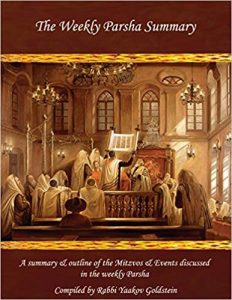
*The article below is an excerpt from the above Sefer
*As an Amazon Associate I earn from qualifying purchases.
 Donate
Shevi’i
- Sanctifying the first born:
- Hashem spoke to Moshe asking him to command the Jewish people: Every male firstborn of the womb of a person or animal is to be sanctified to me. The firstborn male is to be redeemed.
- Firstborn donkey: Every firstborn donkey is to be redeemed with a lamb or kid, and if not then one is to break its neck.
- If your children ask what this [Mitzvah] is [about], then you shall tell him that Hashem took us out from slavery with a strong hand, and he killed the Egyptian firstborns, and therefore I sacrifice to G-d my firstborn male animals, and redeem my firstborn sons.
- Moshe instructs the Jewish people the Pesach laws and commands:
- Chametz and Matzah: Moshe spoke to the Jewish people telling them of Hashem’s commands not to eat Chametz during the seven days of Pesach and to celebrate the seventh day. To eat Matzos during the seven days, and not to see Chametz in one’s possession.
- Mitzvah of Vehegadeta LeBincha: You shall tell your children on this day that it is on account of this that Hashem took you out of Egypt.
- Mitzvah of Tefillin: The above is to be made a sign on your hand and a remembrance between your eyes, in order so the Torah of Hashem remain on your mouths.
- Why does the Torah say “פֶּטֶר כָל־רֶחֶם” (the one that first opened the womb)?
Answer:
Rashi explains that the root פֶּטֶר means “opening.” It refers to the first issue of the womb, the one that opens it. He brings examples from other verses where the root means “to open,” like “one who makes an opening for water to gush forth.”
- Why does God say “לִי הוּא” (It is Mine)?
Answer:
Rashi says God acquired the firstborn for Himself because He killed the Egyptian firstborn during the plague. Therefore, the Israelite firstborn belong to Him.
- Why does the Torah say “זָכוֹר אֶת־הַיּוֹם הַזֶּה” (Remember this day)?
Answer:
Rashi teaches that the phrase “this day” means we must mention the Exodus every day, not only on Passover.
- Why mention “בְּחֹדֶשׁ הָאָבִיב” (in the month of ripening)? Didn’t they know the month?
Answer:
Rashi explains that this shows God’s kindness: He took them out in a pleasant season—not too hot, cold, or rainy—making the journey easier.
- Why does the Torah repeat the command about the Passover service?
Answer:
Rashi says the repetition introduces something new: the obligation to teach even a child who does not know how to ask, starting with stories and explanations to spark interest.
- What does “בַּעֲבוּר זֶה” (for the sake of this) mean?
Answer:
Rashi explains it means: “So that I fulfill God’s commandments, such as these before me—the Passover offering, matzah, and bitter herbs.”
- Why is tefillin mentioned here as a sign?
Answer:
Rashi says the passages about the Exodus must be written on scrolls and bound on the arm and head as tefillin, serving as a sign and reminder of redemption.
- What does “וּלְטוֹטָפֹת” mean?
Answer:
Rashi gives two explanations:
- It refers to tefillin with four compartments (since “טָט” in Coptic means two and “פַּת” in Phrygian means two).
- Menachem ben Saruk connects it to speech, meaning the tefillin remind us to speak about the Exodus.
Related Articles
📜Daily Chumash & Rashi Parshas Tzav – Shishi: The second inauguration ram (Friday 9th Nissan)
Post Views: 1,007 *The article below is an excerpt from the above Sefer *As an Amazon Associate I earn from qualifying purchases. Donate Buy in Paperback or Kindle Buy on Apple Books Purchase on our website Sign up for Daily Distribution Sponsor an Episode Shishi The second inauguration ram: Aaron
📜Daily Chumash & Rashi Parshas Tzav – Chamishi: Offering the Karbanos by the inauguration (Thursday 8th Nissan)
Post Views: 1,485 *The article below is an excerpt from the above Sefer *As an Amazon Associate I earn from qualifying purchases. Donate Buy in Paperback or Kindle Buy on Apple Books Purchase on our website Sign up for Daily Distribution Sponsor an Episode Chamishi Offering the Karbanos by the
📜Daily Chumash & Rashi Parshas Tzav – Revi: The inauguration of Aaron and his sons (Wednesday 7th Nissan)
Post Views: 1,331 *The article below is an excerpt from the above Sefer *As an Amazon Associate I earn from qualifying purchases. Donate Buy in Paperback or Kindle Buy on Apple Books Purchase on our website Sign up for Daily Distribution Sponsor an Episode Revi’i The inauguration of Aaron and
📜Daily Chumash & Rashi Parshas Tzav – Shelishi: The Karban Shelamim (Tuesday, 6th Nissan)
Post Views: 1,423 *The article below is an excerpt from the above Sefer *As an Amazon Associate I earn from qualifying purchases. Donate Buy in Paperback, Kindle, or Audible Buy on Apple Books Purchase on our website Sign up for Daily Distribution Sponsor an Episode The laws of the Shlamim,
📜 Daily Chumash & Rashi Parshas Tzav – Sheiyni: The Karban Chatas and Asham (Monday 5th Nissan)
Post Views: 1,523 *The article below is an excerpt from the above Sefer *As an Amazon Associate I earn from qualifying purchases. Donate Buy in Paperback or Kindle Buy on Apple Books Purchase on our website Sign up for Daily Distribution Sponsor an Episode Sheiyni The Karban of the Kohanim
📜Daily Chumash & Rashi Parshas Tzav – Rishon: Terumas Hadeshen and the Mincha offering (Sunday 4th nissan)
Post Views: 1,547 *The article below is an excerpt from the above Sefer *As an Amazon Associate I earn from qualifying purchases. Donate Buy in Paperback or Kindle Buy on Apple Books Purchase on our website Sign up for Daily Distribution Sponsor an Episode Parshas Tzav Pesukim: 97 [Siman: