

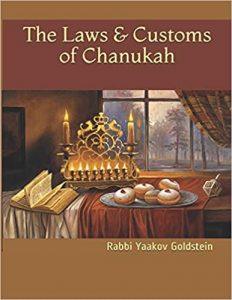
This Article is an excerpt from the above Sefer
*As an Amazon Associate I earn from qualifying purchases.
 Donate
Table of Contents
Zos Chanukah-The last day of Chanukah
A. Its name:
The eighth day of Chanukah is called Zos Chanukah.[1]
The revelation on this day:[2]
On this day, there shines a great amount of G-dly light which is able to refine the greatest depths of evil.
Increasing in Torah learning:[3]
One is to increase in Torah learning on this day.
Making up missed Avoda:[4]
On this day one can complete all matters of Chanukah which were not yet accomplished on the previous days.
Kerias Hatorah:[5]
On the last day of Chanukah, the reading begins from “Ubeyom Hashmini” and concludes by “Asa Es Hamenorah” in Parshas Behaaloscha. [The Kohen and Levi read the 8th Karban, while the Yisrael reads from the 9th Karban until “Asa Es Hamenorah” in Parshas Behaaloscha.[6]]
Leftover oil and wicks: May one benefit from the oil/wax that remains after the candles have extinguished?[7]
What to do with leftover oil if candle extinguished within a half hour past nightfall: The leftover oil [or wax] of the 8th day’s Chanukah lighting is [forbidden in benefit and is thus] to be burnt on its own, if the candle extinguished prior to burning for a half hour [past nightfall].[8] [This law applies likewise for the leftover oils of the other nights, if the candle extinguished prior to the passing of a half hour after nightfall[9], although regarding the oil of the other nights, one may reuse the leftover oil for the lighting of the next night. However, regarding the oil of the 8th night, the leftover oil must be burned on its own due to it being the last night of Chanukah, and that it has no future use.[10]]
Oil that remains after it was lit for a half hour:[11] If the candle contained more than 30 minutes worth of oil [or wax], then the first thirty minutes of oil [lit past nightfall[12]] is considered designated for the Mitzvah, while the oil [or wax] that remains after these thirty minutes does not contain any Mitzvah status, and may be even initially used for any purpose. [Thus, if the candle extinguished prior to remaining lit for a half hour after nightfall, then it is forbidden in benefit until it is lit for the remainder of the half hour, in which case the remainder is permitted in benefit.[13] However, some Poskim[14] rule that all the oil [or wax] is designated for the Mitzvah, and it thus may not be used for any other purpose. According to all, if one stipulated on his oil that only the oil which burns for the first half hour is designated for the Mitzvah, then the remaining oil may be used for other matters.[15] Practically, it is initially best to suspect for the latter opinion and stipulate upon placing in the oil [or wax], that all oil that remains past a half hour is not sanctified for the Mitzvah.[16] If one explicitly placed more than a half hour worth of oil for the sake of the Mitzvah, then all the leftover oil must be burnt on its own after Chanukah.[17]]
What should one do with the leftover wicks of the Menorah:[18] The leftover wicks of the Menorah are likewise to be burnt.
If the leftover oil mixed with other oil:[19] If the leftover Mitzvah[20] oil became mixed with other oil, it is nullified in 60x. If the mixture does not contain 60x then the entire mixture is forbidden in benefit and is required to be burnt on its own. Some Poskim[21] rule one may not add more oil to the mixture in order to nullify it in 60x.[22] [Other Poskim[23] however rule that if one has more oil, he may add it to the mixture until it is nullified in 60x. Practically, we rule stringently in this matter.[24]] [The above case refers to oil that became mixed with other oil. However, if the actual candle that was used for the Chanukah lighting became mixed with other candles, then it is not nullified even in 1000x, as explained in A.]
Summary: After Chanukah, the leftover oils or wax of the first half hour, and the wicks which were used to light the Chanukah candles, must be burnt on their own. It is forbidden to use them for any other purposes. It is proper to stipulate before Chanukah that the oil or wax which remains after the 30 minutes of lighting is not considered designated for the Mitzvah, and hence, according to all, does not require burning after Chanukah. Q&A Must one burn the leftover oil that remains in the bottle? May this oil be used for other purposes?[25] The leftover oil that remains in the bottle is not considered Holy, and may hence be used for whatever purpose one desires. One is not required to burn this oil, and it may be used as fuel for other purposes, or for eating, if the oil is edible.
Must one burn the leftover oil of a child?[26] Yes. It follows the same law as the leftover oil of an adult.
May one save the leftover oil of the first half hour to use for next Chanukah?[27] No.[28]
When is the oil to be burnt? It is forbidden to own the oil for a long period of time, due to fear one may come to benefit from it.[29] The oil must thus be burnt within one to two months from the end of Chanukah.[30] Many are accustomed to burn it on the 8th day of Chanukah, in the morning after that nights lighting.
May the leftover oil of the first half hour be used to light Shabbos candles, or other Mitzvah purpose?[31] No.
Must one burn the leftover wax of the wax candles? If the candle extinguished within 30 minutes after nightfall, then the area of wax that is part of the 30 minute lighting is required to be burnt after Chanukah. However, the part of the wax candle that lasts past 30 minutes is not required to be burnt. Likewise, if the candle was lit for a half hour after nightfall, it is not required to be burnt. Nevertheless, it is initially proper to stipulate before Chanukah that the wax that remains past a half hour is not part of the Mitzvah designation, as stated above.
|
Segula to use leftover oil: There is a tradition from the Kotzker Rebbe that the leftover Chanukah oil contains a Segula against cellulitis/Shoshana. According to the tradition, one who has cellulitis is to smear the oil over the affected area. [Seemingly however this refers only to oil that remains after being lit a half hour after nightfall, as otherwise the oil is forbidden in benefit.]
|
From the Rav’s Desk
From the Rav’s Desk – Saving the leftover wicks and oil of the Menorah for the burning of Chametz on Erev Pesach
Question: [Wednesday, 4th Teves, 5782]
I have heard that many people save the oil and wicks of the Chanukah Menorah for the burning of chametz by erev Pesach. Is this allowed to be done or must one burn it right away?
Answer:
Although some are accustomed to save the leftover wicks and oil for burning on erev Pesach, in my opinion, one should not follow this custom and is to burn it right away, as is the simple understanding of the Poskim.
Explanation: It is a clear ruling in the Poskim that the leftover oil must be burned after Chanukah being that it is forbidden in benefit. The Poskim extend this ruling likewise to the leftover wicks. Accordingly, the wicks and oil should be burned right away, within 1-2 months, as is always the law regarding any item that it is forbidden in use that one may not own it for a long time, lest one come to forget and accidentally use it. Accordingly, the Poskim explicitly rule that it may not be saved to be used for the next Chanukah, due to this worry, and hence likewise the same would apply regarding saving it until Erev Pesach. Indeed, the custom of majority of Jewry is to follow this ruling and burn the leftover wicks and oil right away on Zos or Motzei Chanukah. Nonetheless, some are accustomed to save it until erev Pesach by the burning of the Chametz, seemingly based on the fact that usually all of the leftover oils are all past a half-hour, and therefore do not really have a requirement to be burned at all. Practically, however, in my opinion this should not be followed as aside for the fact that at times oil that is within a half-hour is leftover, the wicks themselves need to be burned, and hence need to be burned right away.
Sources: See regarding the obligation to burn the oil: Michaber 677:4; Tur 677:4; Rosh Shabbos 9; Sheilasos Rav Achaiy;Mordechai;Hagahos Maimanis Chanukah 4:4; M”A 677:10; M”B 677:18; Kaf Hachaim 677:26-27; See also Michaber 672:2; See regarding the obligation to burn the wicks: Tur 677:4; Beis Yosef 677:4; Ran Shabbos 21b; Ohel Moed Chanukah; Abudarham Chanukah; Seder Hayom; Tzeida Laderech Chanukah; Chayeh Adam 154:31; Or Tzadikim 24:13; Kitzur SHU”A 139:20; See Kaf Hachaim 677:26 in name of Levush See regarding the general prohibition to hold onto an item prohibited in use: Michaber Y.D. 57:20; Shach 84:17; Taz Y.D. 84:7; Rashal Perek Eilu Treifos 125, brought in Taz and Shach ibid; Admur 435:4; 447:1 [1-2 months]; Kuntrus Achron 446:1; Admur 447:1; See Shach 57:47 “21 days is a short time”; Michaber ibid “12 months”; See regarding saving the leftover oil to use for next Chanukah: M”A 677:11; Tur 677; Levush; M”B 677:19; Kaf Hachaim 677:29; See regarding the custom of saving the leftover oil to use for Erev Pesach Chametz burning: Piskeiy Teshuvos 677:9 footnote 59; 445:5; Nitei Gavriel 57:2; See Maaseh Melech p. 309 [in my opinion, nothing can be derived from what it states there, and on the contrary..]
Ask the Rav – Real-Life Q&A
Ask the Rav Question #1:
May one save the leftover Hanukkah oil to burn together with the burning of the chametz? I heard a rabbi in school say that this is the custom, but I always thought it needed to be burned the next day.
Answer:
Indeed, you are correct. According to halacha, the leftover oil and wicks should be burned right away, preferably by the next day, to ensure that one does not come to use them. This follows the general rule for all items that are forbidden for benefit: they should not remain in the home lest one accidentally derive benefit from them. While saving things to burn with the chametz is a virtuous concept, that only applies to items that are not prohibited for benefit—such as the aravos and lulav—but not to items like leftover Hanukkah oil and wicks, which are forbidden for benefit.
Sources:
See M”A 677:11; Tur 677; Levush; M”B 677:19; Kaf Hachaim 677:29; See our corresponding Sefer “The Laws of Chanukah” Chapter 3 Halacha 21D in Q&A; https://shulchanaruchharav.com/owning-non-kosher-food/ ; https://shulchanaruchharav.com/halacha/from-the-ravs-desk-saving-the-leftover-wicks-and-oil-of-the-menorah-for-the-burning-of-chametz-on-erev-pesach/
When to extinguish the shul Menorah lighting:[32]
The Rebbe directed that on Zos Chanukah, the last day of Chanukah, the Menorah is to remain lit even after the leave of Chanukah, until it extinguishes on its own.
Tachanun:
Tachanun is resumed starting from the day after the 8th of Chanukah.
_________________________________________
[1] Sefer Haminhagim P. 161 [English]
The reason: This term follows the words “Zos Chanukas Hamizbeiach” which is read from the Torah on the 8th day of Chanukah. See Shaar Hamoadim Chanukah for a lengthy Sicha regarding why only the last day of Chanukah is called Zos Chanukah, as on Chanukah the main aspect is the Mikbael/Bepoel, as rules Beis Hilel, and hence only the last day in actuality has all eight lights lit.
[2] Shaar Hamoadim Chanukah 71
[3] Based on Shaar Hamoadim Chanukah 70
[4] Shaar Hamoadim Chanukah 72
[5] Rama 684:1; Sefer Haminhagim p. 161 [English]
Other opinions: Some Poskim rule one concludes with the first Parsha of Behaaloscha. [Michaber ibid]
[6] Darkei Moshe 684:2; Elya Raba 684:4; M”B 684:4
[7] 677:4
[8] Michaber ibid as explained in M”B 677:18 that “Hatzarich Leshiur Hadlaka” means that there was enough oil to last 30 minutes and it extinguished before that time; So also explains Levush; Kaf Hachaim 677:26
The reason: As the oil of the half hour of burning as designated for its Mitzvah. [Michaber ibid] Now, although we rule that all Tashmishei Mitzvah may be used for mundane matters after the Mitzvah is complete [see Admur 21:1 and 42:6] nevertheless, here, it is forbidden being that one intended for all this oil to be used up, and it is hence considered designated for the Mitzvah, similar to Hekdesh. [See Ramban Shabbos 21b]
[9] M”A 673:8; Elya Raba 673:11; Peri Chadash 673; Kneses Hagedola 673:8; Mahariy Bruno 51; Kaf Hachaim 673:47
[10] Tur; Levush; M”B 677:17; Kaf Hachaim 677:26
[11] Michaber ibid as explained in M”A 677:10 and M”B 677:18; Kaf Hachaim 677:26-27; See also Michaber 672:2
[12] See Biur Halacha 671:1 “Ubilvad”
[13] Michaber 677:4; M”A 673:8; Elya Raba 673:11; Peri Chadash 673; Kneses Hagedola 673:8; Mahariy Bruno 51; Kaf Hachaim 673:47
[14] Mahariy brought in Beis Yosef 677; Bach and Tzeida Laderech, brought in M”A 672:4; 677:10; Peri Chadash 677; brought in M”B ibid; Kaf Hachaim 677:26
[15] M”B 677:18; Poskim in next footnote
[16] M”A 677:10; Elya Raba 672:2; Chayeh Adam; Poskim brought in M”B 677:18; 672:7; Kaf Hachaim 672:21
[17] Levush; Kaf Hachaim 677:26
[18] Kitzur SHU”A 139:20; Tur; Beis Yosef; See Kaf Hachaim 677:26 in name of Levush
[19] Michaber 677:4
[20] This refers to the oil that remains when a candle extinguished prior to a half hour after nightfall, whether of the 8th night, or of any other night of Chanukah, as explained above. However, the oil that remains after a half hour after nightfall, is not considered Mitzvah oil according to the many opinions, and hence Bedieved if the oil mixed, nullification is not required, even if a stipulation was not made. [Machatzis Hashekel 673:8; Kaf Hachaim 673:48] However, some Poskim rule that according to those who hold that one may not make use of the candles even after the passing of a half hour, then if the candles get mixed up even after a half hour, they are not nullified. [Peri Chadash 673, brought in Kaf Hachaim 673:48]
[21] Yeish Mi Sheomer in Michaber ibid; Rama Y.D. 99:6; Tur in name of Mahram of Rothenberg; Rosh; M”A 677:12; Suggestion of Shach 99:19; Elya Raba 677:7; Metzudas Yissachar 19; Ikkareiy Hadaat 35:32; Pischeiy Teshuvah; Kaf Hachaim 677:31
[22] The reason: As it is forbidden to nullify an Issur Lechatchila. [Rama ibid] It is not similar to the law regarding adding more wood to forbidden wood on Yom Tov, being that the benefit of the wood is only received after it turns to ash. [M”A 677:12; Tur 677; Levush 677; Kaf Hachaim 677:30; See Admur 507:3]
[23] Michaber Y.D. 99:6 [brought in M”A 677:12; M”B 67720]; Rashba; Rashal brought in Taz 99:12; Taz 677:4; Peri Chadash 677; Shulchan Gavoa 677:8
The contradiction in Michaber: In Y.D. ibid the Michaber rules that one may add Heter to nullify a Rabbinical Issur. This seemingly contradicts his ruling here 677:4 that one may not add Heter oil to the mixture to nullify it in 60x. [Taz 99:12] Some Poskim therefore conclude that in truth, based on the Michaber in 99:6, one may add oil to the mixture, and the above opinion in 677:4 is a Daas Yachid. [Taz 677:4; Peri Chadash 677; Shulchan Gavoa 677:8] The Shach 99:19 however suggests that items which are forbidden in benefit due to sacrilege [i.e. using Mitzvah oil for mundane activity] are more severe in their laws then a regular Rabbinical Issur, and hence, there is no contradiction in the Michaber’s rulings. Nevertheless, the Shach concludes with a Tzaruch Iyun. [The Shach questions this answer based on the fact that the source of the stringent opinion brought by the Michaber in 677:4 is the Mahram Rotenberg which is proven to hold like the Rama that one may not add Heter to even Rabbinical Issurim.] The Magen Avraham 677:12 suggests that perhaps Chanukah oil is more stringent as it has a status of Davar Sheyeish Lo Matirin [As the oil will become permitted next year by Chanukah]. Some Poskim however question this assertion. [The Beir Heiytiv [Yoreh Deah 99:14; Orach Chaim 677:5] and Rav Akiva Eiger ask on this answer of the Magen Avraham that if in truth the oil were a Davar Sheyeish Lo Matirin then it would never be nullified even in a 1000x while the Michaber suggests that if there were 60x it would be nullified.]
[24] As so rules Rama ibid, and even according to Michaber, many Poskim understand him to rule stringently in this case
[25] Pashut; Biur Halacha 677:4 “Hatzarich”
[26] Shevet Hakehasi 3:204; Piskeiy Teshuvos 677:8; based on Sukkah 45a that the Esrog of a child receives Kedusha
[27] M”A 677:11; Tur 677; Levush; M”B 677:19; Kaf Hachaim 677:29
[28] The reason: As we suspect that one may come to use it in the interim, either for eating or for lighting. [ibid]
[29] See Michaber Y.D. 57/20; Shach 84/17; Taz Y.D. 84/7; Rashal Perek Eilu Treifos 125, brought in Taz and Shach ibid; Admur 435/4; 447/1; Kuntrus Achron 446/1
[30] Admur 447/1; See Shach 57/47 “21 days is a short time”; Michaber ibid “12 months”
Saving the oil to burn with the Chametz on Erev Pesach: As stated above, it is forbidden to saver the oil for more than 1-2 months. Nonetheless, some are accustomed to save the oil for the burning of the Chametz on Erev Pesach. This is due to that a) today people no longer make use of this oil, and there is hence no suspicion of coming to benefit from it in the interim. B) The oil is usually from a half hour past nightfall, and hence may be benefited from, according to the letter of the law. Nonetheless, it is not to be used to help fuel the burning of the Chametz, as the oil is forbidden in benefit [if it is from within a half hour][See Piskeiy Teshuvos 677:9; 445:5]
[31] Implication of Michaber ibid; Piskeiy Teshuvos 677:9; See Aruch Hashulchan 677:6; Chochmas Shlomo 677; Shraga Hameir 5:118
[32] Hiskashrus Chanukah based on oral directives given by the Rebbe in a number of years
is called Zos Chanukah.[1]
B. The revelation on this day:[2]
On this day, there shines a great amount of G-dly light which is able to refine the greatest depths of evil.
C. Increasing in Torah learning:[3]
One is to increase in Torah learning on this day.
D. Making up missed Avoda:[4]
On this day one can complete all matters of Chanukah which were not yet accomplished on the previous days.
E. Kerias Hatorah:[5]
On the last day of Chanukah, the reading begins from “Ubeyom Hashmini” and concludes by “Asa Es Hamenorah” in Parshas Behaaloscha. [The Kohen and Levi read the 8th Karban, while the Yisrael reads from the 9th Karban until “Asa Es Hamenorah” in Parshas Behaaloscha.[6]]
F. Leftover oil and wicks: May one benefit from the oil/wax that remains after the candles have extinguished?[7]
What to do with leftover oil if candle extinguished within a half hour past nightfall: The leftover oil [or wax] of the 8th day’s Chanukah lighting is [forbidden in benefit and is thus] to be burnt on its own, if the candle extinguished prior to burning for a half hour [past nightfall].[8] [This law applies likewise for the leftover oils of the other nights, if the candle extinguished prior to the passing of a half hour after nightfall[9], although regarding the oil of the other nights, one may reuse the leftover oil for the lighting of the next night. However, regarding the oil of the 8th night, the leftover oil must be burned on its own due to it being the last night of Chanukah, and that it has no future use.[10]]
Oil that remains after it was lit for a half hour:[11] If the candle contained more than 30 minutes worth of oil [or wax], then the first thirty minutes of oil [lit past nightfall[12]] is considered designated for the Mitzvah, while the oil [or wax] that remains after these thirty minutes does not contain any Mitzvah status, and may be even initially used for any purpose. [Thus, if the candle extinguished prior to remaining lit for a half hour after nightfall, then it is forbidden in benefit until it is lit for the remainder of the half hour, in which case the remainder is permitted in benefit.[13] However, some Poskim[14] rule that all the oil [or wax] is designated for the Mitzvah, and it thus may not be used for any other purpose. According to all, if one stipulated on his oil that only the oil which burns for the first half hour is designated for the Mitzvah, then the remaining oil may be used for other matters.[15] Practically, it is initially best to suspect for the latter opinion and stipulate upon placing in the oil [or wax], that all oil that remains past a half hour is not sanctified for the Mitzvah.[16] If one explicitly placed more than a half hour worth of oil for the sake of the Mitzvah, then all the leftover oil must be burnt on its own after Chanukah.[17]]
What should one do with the leftover wicks of the Menorah:[18] The leftover wicks of the Menorah are likewise to be burnt.
If the leftover oil mixed with other oil:[19] If the leftover Mitzvah[20] oil became mixed with other oil, it is nullified in 60x. If the mixture does not contain 60x then the entire mixture is forbidden in benefit and is required to be burnt on its own. Some Poskim[21] rule one may not add more oil to the mixture in order to nullify it in 60x.[22] [Other Poskim[23] however rule that if one has more oil, he may add it to the mixture until it is nullified in 60x. Practically, we rule stringently in this matter.[24]] [The above case refers to oil that became mixed with other oil. However, if the actual candle that was used for the Chanukah lighting became mixed with other candles, then it is not nullified even in 1000x, as explained in A.]
Summary: After Chanukah, the leftover oils or wax of the first half hour, and the wicks which were used to light the Chanukah candles, must be burnt on their own. It is forbidden to use them for any other purposes. It is proper to stipulate before Chanukah that the oil or wax which remains after the 30 minutes of lighting is not considered designated for the Mitzvah, and hence, according to all, does not require burning after Chanukah. Q&A Must one burn the leftover oil that remains in the bottle? May this oil be used for other purposes?[25] The leftover oil that remains in the bottle is not considered Holy, and may hence be used for whatever purpose one desires. One is not required to burn this oil, and it may be used as fuel for other purposes, or for eating, if the oil is edible. Must one burn the leftover oil of a child?[26] Yes. It follows the same law as the leftover oil of an adult. May one save the leftover oil of the first half hour to use for next Chanukah?[27] No.[28] When is the oil to be burnt? It is forbidden to own the oil for a long period of time, due to fear one may come to benefit from it.[29] The oil must thus be burnt within one to two months from the end of Chanukah.[30] Many are accustomed to burn it on the 8th day of Chanukah, in the morning after that nights lighting. May the leftover oil of the first half hour be used to light Shabbos candles, or other Mitzvah purpose?[31] No. Must one burn the leftover wax of the wax candles? If the candle extinguished within 30 minutes after nightfall, then the area of wax that is part of the 30 minute lighting is required to be burnt after Chanukah. However, the part of the wax candle that lasts past 30 minutes is not required to be burnt. Likewise, if the candle was lit for a half hour after nightfall, it is not required to be burnt. Nevertheless, it is initially proper to stipulate before Chanukah that the wax that remains past a half hour is not part of the Mitzvah designation, as stated above. |
Segula to use leftover oil: There is a tradition from the Kotzker Rebbe that the leftover Chanukah oil contains a Segula against cellulitis/Shoshana. According to the tradition, one who has cellulitis is to smear the oil over the affected area. [Seemingly however this refers only to oil that remains after being lit a half hour after nightfall, as otherwise the oil is forbidden in benefit.]
|
G. When to extinguish the shul Menorah lighting:[32]
The Rebbe directed that on Zos Chanukah, the last day of Chanukah, the Menorah is to remain lit even after the leave of Chanukah, until it extinguishes on its own.
H. Tachanun:
Tachanun is resumed starting from the day after the 8th of Chanukah.
____________________________________
[1] Sefer Haminhagim P. 161 [English]
The reason: This term follows the words “Zos Chanukas Hamizbeiach” which is read from the Torah on the 8th day of Chanukah. See Shaar Hamoadim Chanukah for a lengthy Sicha regarding why only the last day of Chanukah is called Zos Chanukah, as on Chanukah the main aspect is the Mikbael/Bepoel, as rules Beis Hilel, and hence only the last day in actuality has all eight lights lit.
[2] Shaar Hamoadim Chanukah 71
[3] Based on Shaar Hamoadim Chanukah 70
[4] Shaar Hamoadim Chanukah 72
[5] Rama 684:1; Sefer Haminhagim p. 161 [English]
Other opinions: Some Poskim rule one concludes with the first Parsha of Behaaloscha. [Michaber ibid]
[6] Darkei Moshe 684:2; Elya Raba 684:4; M”B 684:4
[7] 677:4
[8] Michaber ibid as explained in M”B 677:18 that “Hatzarich Leshiur Hadlaka” means that there was enough oil to last 30 minutes and it extinguished before that time; So also explains Levush; Kaf Hachaim 677:26
The reason: As the oil of the half hour of burning as designated for its Mitzvah. [Michaber ibid] Now, although we rule that all Tashmishei Mitzvah may be used for mundane matters after the Mitzvah is complete [see Admur 21:1 and 42:6] nevertheless, here, it is forbidden being that one intended for all this oil to be used up, and it is hence considered designated for the Mitzvah, similar to Hekdesh. [See Ramban Shabbos 21b]
[9] M”A 673:8; Elya Raba 673:11; Peri Chadash 673; Kneses Hagedola 673:8; Mahariy Bruno 51; Kaf Hachaim 673:47
[10] Tur; Levush; M”B 677:17; Kaf Hachaim 677:26
[11] Michaber ibid as explained in M”A 677:10 and M”B 677:18; Kaf Hachaim 677:26-27; See also Michaber 672:2
[12] See Biur Halacha 671:1 “Ubilvad”
[13] Michaber 677:4; M”A 673:8; Elya Raba 673:11; Peri Chadash 673; Kneses Hagedola 673:8; Mahariy Bruno 51; Kaf Hachaim 673:47
[14] Mahariy brought in Beis Yosef 677; Bach and Tzeida Laderech, brought in M”A 672:4; 677:10; Peri Chadash 677; brought in M”B ibid; Kaf Hachaim 677:26
[15] M”B 677:18; Poskim in next footnote
[16] M”A 677:10; Elya Raba 672:2; Chayeh Adam; Poskim brought in M”B 677:18; 672:7; Kaf Hachaim 672:21
[17] Levush; Kaf Hachaim 677:26
[18] Kitzur SHU”A 139:20; Tur; Beis Yosef; See Kaf Hachaim 677:26 in name of Levush
[19] Michaber 677:4
[20] This refers to the oil that remains when a candle extinguished prior to a half hour after nightfall, whether of the 8th night, or of any other night of Chanukah, as explained above. However, the oil that remains after a half hour after nightfall, is not considered Mitzvah oil according to the many opinions, and hence Bedieved if the oil mixed, nullification is not required, even if a stipulation was not made. [Machatzis Hashekel 673:8; Kaf Hachaim 673:48] However, some Poskim rule that according to those who hold that one may not make use of the candles even after the passing of a half hour, then if the candles get mixed up even after a half hour, they are not nullified. [Peri Chadash 673, brought in Kaf Hachaim 673:48]
[21] Yeish Mi Sheomer in Michaber ibid; Rama Y.D. 99:6; Tur in name of Mahram of Rothenberg; Rosh; M”A 677:12; Suggestion of Shach 99:19; Elya Raba 677:7; Metzudas Yissachar 19; Ikkareiy Hadaat 35:32; Pischeiy Teshuvah; Kaf Hachaim 677:31
[22] The reason: As it is forbidden to nullify an Issur Lechatchila. [Rama ibid] It is not similar to the law regarding adding more wood to forbidden wood on Yom Tov, being that the benefit of the wood is only received after it turns to ash. [M”A 677:12; Tur 677; Levush 677; Kaf Hachaim 677:30; See Admur 507:3]
[23] Michaber Y.D. 99:6 [brought in M”A 677:12; M”B 67720]; Rashba; Rashal brought in Taz 99:12; Taz 677:4; Peri Chadash 677; Shulchan Gavoa 677:8
The contradiction in Michaber: In Y.D. ibid the Michaber rules that one may add Heter to nullify a Rabbinical Issur. This seemingly contradicts his ruling here 677:4 that one may not add Heter oil to the mixture to nullify it in 60x. [Taz 99:12] Some Poskim therefore conclude that in truth, based on the Michaber in 99:6, one may add oil to the mixture, and the above opinion in 677:4 is a Daas Yachid. [Taz 677:4; Peri Chadash 677; Shulchan Gavoa 677:8] The Shach 99:19 however suggests that items which are forbidden in benefit due to sacrilege [i.e. using Mitzvah oil for mundane activity] are more severe in their laws then a regular Rabbinical Issur, and hence, there is no contradiction in the Michaber’s rulings. Nevertheless, the Shach concludes with a Tzaruch Iyun. [The Shach questions this answer based on the fact that the source of the stringent opinion brought by the Michaber in 677:4 is the Mahram Rotenberg which is proven to hold like the Rama that one may not add Heter to even Rabbinical Issurim.] The Magen Avraham 677:12 suggests that perhaps Chanukah oil is more stringent as it has a status of Davar Sheyeish Lo Matirin [As the oil will become permitted next year by Chanukah]. Some Poskim however question this assertion. [The Beir Heiytiv [Yoreh Deah 99:14; Orach Chaim 677:5] and Rav Akiva Eiger ask on this answer of the Magen Avraham that if in truth the oil were a Davar Sheyeish Lo Matirin then it would never be nullified even in a 1000x while the Michaber suggests that if there were 60x it would be nullified.]
[24] As so rules Rama ibid, and even according to Michaber, many Poskim understand him to rule stringently in this case
[25] Pashut; Biur Halacha 677:4 “Hatzarich”
[26] Shevet Hakehasi 3:204; Piskeiy Teshuvos 677:8; based on Sukkah 45a that the Esrog of a child receives Kedusha
[27] M”A 677:11; Tur 677; Levush; M”B 677:19; Kaf Hachaim 677:29
[28] The reason: As we suspect that one may come to use it in the interim, either for eating or for lighting. [ibid]
[29] See Michaber Y.D. 57/20; Shach 84/17; Taz Y.D. 84/7; Rashal Perek Eilu Treifos 125, brought in Taz and Shach ibid; Admur 435/4; 447/1; Kuntrus Achron 446/1
[30] Admur 447/1; See Shach 57/47 “21 days is a short time”; Michaber ibid “12 months”
Saving the oil to burn with the Chametz on Erev Pesach: As stated above, it is forbidden to saver the oil for more than 1-2 months. Nonetheless, some are accustomed to save the oil for the burning of the Chametz on Erev Pesach. This is due to that a) today people no longer make use of this oil, and there is hence no suspicion of coming to benefit from it in the interim. B) The oil is usually from a half hour past nightfall, and hence may be benefited from, according to the letter of the law. Nonetheless, it is not to be used to help fuel the burning of the Chametz, as the oil is forbidden in benefit [if it is from within a half hour][See Piskeiy Teshuvos 677:9; 445:5]
[31] Implication of Michaber ibid; Piskeiy Teshuvos 677:9; See Aruch Hashulchan 677:6; Chochmas Shlomo 677; Shraga Hameir 5:118
[32] Hiskashrus Chanukah based on oral directives given by the Rebbe in a number of years
Table of Laws
Section | Details |
Its name | The eighth day of Chanukah is called Zos Chanukah. |
The revelation on this day | There shines a great amount of G-dly light which is able to refine the greatest depths of evil. |
Increasing in Torah learning | One is to increase in Torah learning on this day. |
Making up missed Avoda | One can complete all matters of Chanukah which were not yet accomplished on the previous days. |
Kerias Hatorah | Reading begins from “Ubeyom Hashmini” and concludes by “Asa Es Hamenorah” in Parshas Behaaloscha. Kohen and Levi read the 8th Karban, Yisrael reads from the 9th Karban until “Asa Es Hamenorah”. |
Leftover oil and wicks | Leftover oil/wax of 8th day’s Chanukah lighting is to be burnt if candle extinguished prior to burning for a half hour past nightfall. Oil of other nights may be reused for next night, except for 8th night. Oil that remains after 30 minutes may be used for any purpose. Some Poskim rule all oil is designated for the Mitzvah. Best to stipulate before Chanukah that oil past a half hour is not sanctified. Leftover wicks are likewise to be burnt. If leftover oil mixed with other oil, it is nullified in 60x. If mixture does not contain 60x, entire mixture is forbidden and must be burnt. Some Poskim rule one may not add more oil to nullify, others allow it; practically, rule stringently. If actual candle used for Chanukah lighting mixed with other candles, it is not nullified even in 1000x. |
Q&A: Oil in bottle | Leftover oil in bottle is not considered Holy, may be used for any purpose, not required to be burnt. |
Q&A: Oil of a child | Follows same law as oil of an adult; must be burnt. |
Q&A: Saving for next Chanukah | No, may not save leftover oil of first half hour to use for next Chanukah. |
Q&A: When to burn oil | Forbidden to own oil for long period, must be burnt within 1-2 months from end of Chanukah. Many burn it on 8th day in morning after lighting. |
Q&A: Using for Shabbos candles or other Mitzvah | No, leftover oil of first half hour may not be used to light Shabbos candles or other Mitzvah purpose. |
Q&A: Leftover wax | If candle extinguished within 30 minutes after nightfall, wax of 30 minute lighting must be burnt. Wax lasting past 30 minutes not required to be burnt. Proper to stipulate before Chanukah that wax past half hour is not designated for Mitzvah. |
Segula to use leftover oil | Tradition from Kotzker Rebbe: leftover Chanukah oil contains Segula against cellulitis/Shoshana; one with cellulitis is to smear oil over affected area. Refers only to oil remaining after being lit a half hour after nightfall. |
Saving wicks and oil for burning Chametz | Some save wicks and oil for burning on erev Pesach, but opinion is to burn right away, within 1-2 months. Custom of majority is to burn right away on Zos or Motzei Chanukah. |
Ask the Rav Q&A | Leftover oil and wicks should be burned right away, preferably by next day, to ensure no benefit is derived. Saving to burn with chametz applies only to items not prohibited for benefit. |
G. Extinguishing shul Menorah | On Zos Chanukah, Menorah is to remain lit even after leave of Chanukah, until it extinguishes on its own. |
H. Tachanun | Tachanun is resumed starting from the day after the 8th of Chanukah. |

Leave A Comment?
You must be logged in to post a comment.