

*As an Amazon Associate I earn from qualifying purchases.
 Donate
Yes, however, Some Poskim rule that after the sewing the Tzitzis must be removed and then retied.
Practically, I would recommend simply purchasing a new pair.
See here
What is the law if the shoulder area of the Tallis Katan tore? – Shulchanaruchharav.com
The purpose of Pesukei Dezimra-To tear the concealments of evil:[1]
Within the prayer, we fulfill the divine services of both Ratzo and Shuv, with the blessings of Shema and the Shema representing the passion of Ratzo, and Shemoneh Esrei representing the return of Shuv. What then does Pesukei Dezimra represents and what is coming to accomplish? The answer is that Pesukei Dezimra accomplishes something very fundamental and necessary to facilitate the future divine services of Ratzo and Shuv in the coming parts of the prayer. In Pesukei Dezimra we sing the praise of G-d as it states, “And he elevates G-d in his throat.” Now, through singing this praise we accomplish the tearing of all the curtains of concealment that hide and darken the revelation of G-dliness from our souls. The singing of praise is comparable to one holding a double edge sword which he uses to whip at the curtain of concealment, until the curtain is torn down, and allows the light to shine through.
[1] Torah Or p. 1d
The concept of Ratzo and Shuv:[1]
The sages state that both the heavens and earth were created for the sake of Torah and for the sake of the Jewish people. Being that this is the case, one must say that there is an aspect of heaven and earth that is found in the Torah as well as in service of G-d through which one is able to establish the physical heaven and earth. The matter is as follows: There exist two different modes of service of G-d, one called Ratzo and the second called Shuv. The service called Ratzo refers to the passion and desire of the heart to cleave to G-d. It comes from the word Ratz, which means to run, as one who is overcome with passion runs towards the subject of his passion to be nullified to it. In general, all the souls of Israel have a subconscious deep passionate desire to cleave to G-d. The divine service of Shuv refers to drawing down G-dliness below, in which we return the G-dliness back onto the earth. So, while in the mode of Ratzo we run towards G-d, in the mode of Shuv, we draw Him down to us. The Divine service of Ratzo is the service that corresponds to the earth while the divine service of Shuv is the divine service that corresponds to the heavens. In today’s times, prior to the redemption, the service of Shuv in which we draw down G-dliness is dependent on preceding it with Ratzo. However, in the future this order will change.
[1] Torah Or p. 1c-d
https://shulchanaruchharav.com/halacha/holding-the-food-in-ones-hand-upon-saying-a-blessing/
https://shulchanaruchharav.com/halacha/shaleim-saying-a-bracha-on-a-whole-food-fruit-vegetable-loaf-cake/
Yes, as it is usually cooked with oil and spices which save the egg from the evil spirit.
See Yaskil Avdi 7/44; Shevet Halaevi 6/111; Hakashrus 18 footnote 50
Peeled eggs, onions and garlic left overnight – Shulchanaruchharav.com
Sotah 12b regarding Yocheved that not only was her son Moshe returned to her by Batya in order so she nurse him, but furthermore she got paid for doing so. On this our sages state, that it does not suffice the righteous receive their lost objects back, but furthermore they receive payment for it.
Other Articles
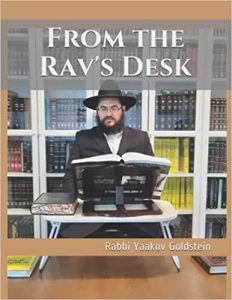
✍️ From the Rav’s Desk: Carrying in a Shared Courtyard with Gentile Neighbors
Post Views: 50 Question: I currently live in a small four‑unit condominium (similar to a townhouse structure), with a single shared outdoor courtyard that is fully enclosed by a gate. Of the four tenants, three are non‑Jewish, and I am the only Jewish resident. Am I required to make an
✍️ From the Rav’s Desk: The Validity of a Pledge of a Now‑Deceased Man
Post Views: 65 Question Dear Rabbi, A very wealthy individual, with whom both my friend and I were well acquainted and on very good terms, told us on several occasions—while we were visiting him in his home—that after he passes away, we may take several items that belong to him.
✍️ From the Rav’s Desk: Tevilat Keilim While Wearing a Glove
Post Views: 51 Question: It is very cold outside, and I would like to know if it is permitted to immerse (toivel) utensils in the mikvah while wearing a glove. Is this allowed? Answer: Yes, there is no issue with immersing utensils while wearing a glove. However, one must ensure
✍️ From the Rav’s Desk: Permissibility of Plucking Fruit and Herbs from Plants Growing in a Cemetery
Post Views: 95 ✍️ From the Rav’s Desk: Permissibility of Plucking Fruit and Herbs from Plants Growing in a Cemetery Question: Dear Rabbi, I was recently visiting a very beautiful and well‑kept Jewish cemetery. Inside the cemetery grounds there were fig trees bearing fruit, as well as numerous rosemary
✍️ From the Rav’s Desk: Permissibility of Torah Study and Prayer in the Presence of a Woman’s Perfume
Post Views: 133 Question: Dear Rabbi, I would like to ask about a situation I recently encountered. I was traveling on the subway and seated across from a woman who was dressed in a manner that was not modest. At the time, I was learning from the daily learning packet
✍️ From the Rav’s Desk: Giving a Child a Haircut During Sefirah
Post Views: 85 Question We have an upcoming wedding of a family member after Lag Baomer, and my child’s hair is in desperate need of a haircut to look representable at the wedding. We are Chabad and generally observe the mourning customs of Sefirah until ערב שבועות and hence avoid


Leave A Comment?
You must be logged in to post a comment.