

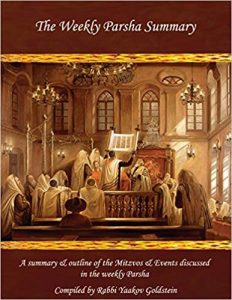
*The article below is an excerpt from the above Sefer
*As an Amazon Associate I earn from qualifying purchases.
 Donate
Shelishi
- A fire came from before Hashem and consumed the offerings, the Olah and the fats. The entire nation witnessed this and praised Hashem and fell on their faces.
- The passing of Nadav and Avihu:
- Nadav and Avihu took a pan with coals and incense and offered a foreign fire to Hashem, of which they were not commanded. A fire came out from Hashem and consumed them, and they died before Hashem.
- Moshe comforted Aaron saying that Hashem had told him that his sons merited to be chosen by Hashem to have the Temple sanctified through them. Aaron was silent.
- Moshe summoned Mishael and Eltzafan, the second cousins of Nadav and Avihu, to remove the bodies of their brothers from the Holy and remove them from the camp. They approached and removed Nadav and Avihu through their clothing to outside the camp.
- Mourning customs: Moshe instructed Aaron and his sons Elazar and Ithamar not to let their hair grow long or tear their clothing, or leave the Ohel Moed, lest they die, and Hashem become wrathful with all the Jewish people. The Jewish people will mourn the burning that Hashem made.
- Not to work while intoxicated:
- Hashem commanded Aaron that the Kohanim may not perform Avoda in the Mikdash under intoxication of alcohol, lest they die. This applies for all generations. This is necessary in order to distinguish between the holy and profane, and pure and impure and for them to instruct the Jewish people the laws of Hashem.
Event | People Involved | Action | Outcome |
Fire consumes offerings | Hashem, entire nation | Fire came from before Hashem and consumed the offerings, Olah and fats | Nation witnessed, praised Hashem, fell on their faces |
Passing of Nadav and Avihu | Nadav, Avihu, Hashem | Took pan with coals and incense, offered foreign fire | Fire consumed them, died before Hashem |
Moshe comforts Aaron | Moshe, Aaron | Moshe said Hashem told him Aaron’s sons merited to sanctify Temple | Aaron was silent |
Removal of bodies | Moshe, Mishael, Eltzafan, Nadav, Avihu | Moshe summoned Mishael and Eltzafan to remove bodies from Holy | Removed Nadav and Avihu outside the camp |
Mourning customs | Moshe, Aaron, Elazar, Ithamar, Jewish people | Moshe instructed not to let hair grow, tear clothing, leave Ohel Moed | Jewish people mourn burning made by Hashem |
Not to work while intoxicated | Hashem, Aaron, Kohanim | Hashem commanded Kohanim not to perform Avoda intoxicated | Necessary to distinguish between holy/profane, pure/impure, instruct laws |
📘 Rashi Q&A — Vayikra 9:24; 10:1–11
9:24 — Fire from Heaven
Q1. What does “וַיָּרֹנּוּ” mean according to Rashi?
A: As Onkelos translates it: they praised.
Q2. How did the people react when the fire descended?
A: They praised G-d and fell upon their faces, prostrating themselves.
10:1 — The Act of Nadav and Avihu
Q3. What did Nadav and Avihu bring before G-d?
A: A foreign fire—incense that G-d had not commanded.
10:2 — The Cause of Their Death
Q4. What explanation does Rabbi Eliezer give for their death?
A: They ruled on a halachic matter (offering incense) in the presence of their teacher Moses.
Q5. What explanation does Rabbi Yishmael give for their death?
A: They entered the Sanctuary after drinking wine.
Q6. How does Rashi support Rabbi Yishmael’s explanation?
A: Because immediately afterward, G-d warns against entering the Sanctuary after drinking wine.
10:3 — G-d Sanctified through the Near Ones
Q7. Where had G-d spoken previously about being sanctified through His honored ones?
A: In the verse: “There I will convene with the Israelites, and it will be sanctified through My glory.”
Q8. How does Rashi reinterpret “בִּכְבֹדִי”?
A: Do not read “through My glory”, but “through My honored ones (בִּמְכֻבָּדַי)”.
Q9. What did Moses say to Aaron about Nadav and Avihu?
A: That Moses thought the Sanctuary would be sanctified through himself or Aaron, but now saw that Nadav and Avihu were even greater.
Q10. What does “בִּקְרֹבַי” mean according to Rashi?
A: Through My chosen and intimate ones.
Q11. What does “וְעַל־פְּנֵי כָל־הָעָם אֶכָּבֵד” teach?
A: When G-d judges the righteous, He becomes feared, exalted, and praised before all the people.
10:3 — Aaron’s Silence
Q12. What does “וַיִּדֹּם אַהֲרֹן” indicate?
A: Aaron was silent and accepted G-d’s judgment.
Q13. What reward did Aaron receive for his silence?
A: He merited that G-d spoke directly to him, regarding intoxication by wine.
10:4–5 — Removal of the Bodies
Q14. Who were Misha’el and Eltzafan?
A: Sons of Uzi’el, Aaron’s uncle.
Q15. Why did Moses tell them to remove the bodies?
A: So as not to diminish the joy of the dedication of the Tabernacle.
Q16. What does Rashi learn from “בְּכֻתֳּנֹתָם”?
A: That their garments were not burned—only their souls were consumed, by fire entering their nostrils.
10:6 — Mourning Restrictions
Q17. What does “אַל־תִּפְרָעוּ” mean according to Rashi?
A: Do not let your hair grow.
Q18. What principle does Rashi derive regarding mourners?
A: A mourner is normally forbidden to cut hair, but Aaron and his sons were told not to mourn so as not to disturb G-d’s joy.
Q19. What is implied by “וְלֹא תָמֻתוּ”?
A: That if they did mourn, they would be liable to death.
Q20. What does Rashi derive from “וַאֲחֵיכֶם כָּל־בֵּית יִשְׂרָאֵל”?
A: That all Israel must mourn when Torah scholars die.
10:7 — Remaining in the Courtyard
Q21. Why were Aaron and his sons forbidden to leave the Courtyard?
A: Because G-d’s anointing oil was upon them.
10:8–9 — Warning Against Intoxication
Q22. What does “יַיִן וְשֵׁכָר” mean?
A: Wine in an intoxicating manner.
Q23. To what situations does the prohibition apply?
A: Not only entering the Tent of Meeting, but also approaching the Altar.
Q24. How does Rashi learn that approaching the Altar is included?
A: By comparing it to the verse about washing hands and feet, where approaching the Altar is equated with entering the Tent.
10:10 — Distinguishing Holy and Profane
Q25. What does “וּלֲהַבְדִּיל” teach?
A: That intoxicated service invalidates the priest’s service.
10:11 — Teaching Torah
Q26. What does “וּלְהוֹרֹת” teach according to Rashi?
A: That an intoxicated person is forbidden to render halachic decisions.
Q27. Does such a person incur the death penalty?
A: No—only priests who serve while intoxicated incur death, not scholars who rule while intoxicated.
Related Articles
📜 Daily Chumash & Rashi Parshas Shemini – Shelishi: The passing of Nadav and Avihu (Tuesday 13th Nissan)
Post Views: 1,227 *The article below is an excerpt from the above Sefer *As an Amazon Associate I earn from qualifying purchases. Donate Buy in Paperback or Kindle Buy on Apple Books Purchase on our website Sign up for Daily Distribution Sponsor an Episode Shelishi A fire came from before
📜Daily Chumash & Rashi Parshas Shemini – Sheiyni: The order of the eighth day of inauguration (Monday 12th Nissan)
Post Views: 1,436 *The article below is an excerpt from the above Sefer *As an Amazon Associate I earn from qualifying purchases. Donate Buy in Paperback or Kindle Buy on Apple Books Purchase on our website Sign up for Daily Distribution Sponsor an Episode Sheiyni The Mincha: The Mincha of
📜 Daily Chumash & Rashi Parshas Shemini – Rishon: The order of the eighth day of inauguration (Sunday 11th Nissan)
Post Views: 1,382 *The article below is an excerpt from the above Sefer *As an Amazon Associate I earn from qualifying purchases. Donate Lorem ipsum dolor sit amet, consectetur adipiscing elit. Ut elit tellus, luctus nec ullamcorper mattis, pulvinar dapibus leo. Buy in Paperback or Kindle Buy on Apple Books
📜Daily Chumash & Rashi Parshas Tzav – Shevi: Eating the sacrifices (Shabbos 10th Nissan)
Post Views: 1,263 *The article below is an excerpt from the above Sefer *As an Amazon Associate I earn from qualifying purchases. Donate Buy in Paperback or Kindle Buy on Apple Books Purchase on our website Sign up for Daily Distribution Sponsor an Episode Shevi’i Anointing the Kohanim with the
📜Daily Chumash & Rashi Parshas Tzav – Shishi: The second inauguration ram (Friday 9th Nissan)
Post Views: 1,017 *The article below is an excerpt from the above Sefer *As an Amazon Associate I earn from qualifying purchases. Donate Buy in Paperback or Kindle Buy on Apple Books Purchase on our website Sign up for Daily Distribution Sponsor an Episode Shishi The second inauguration ram: Aaron
📜Daily Chumash & Rashi Parshas Tzav – Chamishi: Offering the Karbanos by the inauguration (Thursday 8th Nissan)
Post Views: 1,499 *The article below is an excerpt from the above Sefer *As an Amazon Associate I earn from qualifying purchases. Donate Buy in Paperback or Kindle Buy on Apple Books Purchase on our website Sign up for Daily Distribution Sponsor an Episode Chamishi Offering the Karbanos by the

Leave A Comment?
You must be logged in to post a comment.