

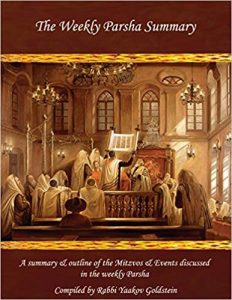
*The article below is an excerpt from the above Sefer
*As an Amazon Associate I earn from qualifying purchases.
 Donate
Shelishi
- Moshe kills the Egyptian and flees:
- Moshe grew up and visited his brethren, witnessing their slavery. He saw an Egyptian man hitting one of his Jewish brothers. Moshe turned both ways, seeing no one around, he struck the Egyptian, killing him and buried him in the ground.
- Moshe flees: The second day he came out he saw two Jews fighting, and admonished the Rasha for hitting his friend. The Rasha replied “Who placed you as a ruler over us, will you kill me like you did to the Egyptian?” Moshe feared that word of the murder would spread, and eventually the news reached Pharaoh who desired to kill him. Moshe fled to Midian to escape death.
- Moshe in Midian, his marriage and children:
- Moshe fled to Midian and settled there.
- Moshe gives the sheep of Yisro to drink: Moshe sat by the well and saw the seven daughters of Yisro, who was the priest of Midian, coming towards the well in order to give water to their father’s flock. The shepherds came and drove them away and Moshe got up and saved them and gave their flock to drink.
- Moshe marries Tzipporah and has children: The daughters came home to Reuel their father [i.e. Yisro] who was surprised at their early return home, and asked them as to the reason. They replied that a certain Egyptian man saved them from the shepherds and gave the flock to drink. Yisro replied that they should not have left the man there, and they should go call him to eat bread with us. Moshe accepted the request and lived in Yisro’s home. Yisro gave his daughter Tzipporah to Moshe as a wife. They had a son whom Moshe named Gershom, in name of the fact that he was a stranger in a foreign land.
- Hashem hears the screams of Bnei Yisrael:
- After many days, the king of Egypt died [i.e. was afflicted with leprosy] and the Jewish people groaned and cried due to the labor. Their scream ascended to G-d and He remembered the covenant he made with Avraham and Yitzchak and Yaakov. Hashem saw the Jewish people and Hashem knew [their suffering].
Q&A on Rashi
Q1: What does “Moshe grew up” mean here, since it was mentioned earlier?
The first mention refers to physical growth; here it means he grew in status—Pharaoh appointed him over his household.
Q2: What does “he observed their suffering” teach us?
Moshe set his eyes and heart to empathize with their pain, sharing in their distress.
Q3: Who was the Egyptian striking the Hebrew, and what was the backstory?
He was a taskmaster who had violated the Hebrew’s wife, Shelomit bat Dibri, and then beat her husband all day after the husband discovered the truth.
Q4: What does “he turned this way and that” mean?
Midrashically, Moshe saw what the Egyptian did at home and in the field; literally, he looked around to ensure no one was present.
Q5: What does “he saw that there was no man” mean?
No one was destined to descend from the Egyptian who would convert to Judaism.
Q6: How did Moshe kill the Egyptian?
By uttering the explicit Name of G‑d.
Q7: Why was Moshe afraid after the incident?
Literally, he feared Pharaoh; Midrashically, he worried that informers among Israel might make them unworthy of redemption.
Q8: What does “so the matter is known” mean?
Literally, the killing was discovered; Midrashically, Moshe realized why Israel suffered—because of internal strife and gossip.
Q9: How did Pharaoh try to kill Moshe, and what happened?
He handed Moshe to the executioner, but the sword miraculously did not harm him.
Q10: Why did Moshe sit by a well in Midian?
He learned from Jacob, who met his wife at a well; wells were common meeting places.
Q11: Why were Yisro’s daughters harassed by shepherds?
Because Yisro had renounced idolatry, and his family was ostracized.
Q12: What does “let him eat bread” mean?
It’s a euphemism for marriage—Yisro hinted that Moshe might marry one of his daughters.
Q13: What does “Moshe consented to stay” mean?
He willingly agreed, and Midrash adds he swore not to leave without Yisro’s permission.
Q14: Why did Moshe name his son Gershom?
Because he said, “I was a stranger in a foreign land.”
Q15: What does “the king of Egypt died” mean?
He was stricken with tzara’at and bathed in Israelite children’s blood as a supposed cure.
Q16: What does “God knew” mean at the end of the chapter?
G‑d paid attention to Israel’s suffering and did not ignore their plight.
Related Articles
📜Daily Chumash & Rashi Parshas Tzav – Shishi: The second inauguration ram (Friday 9th Nissan)
Post Views: 1,009 *The article below is an excerpt from the above Sefer *As an Amazon Associate I earn from qualifying purchases. Donate Buy in Paperback or Kindle Buy on Apple Books Purchase on our website Sign up for Daily Distribution Sponsor an Episode Shishi The second inauguration ram: Aaron
📜Daily Chumash & Rashi Parshas Tzav – Chamishi: Offering the Karbanos by the inauguration (Thursday 8th Nissan)
Post Views: 1,485 *The article below is an excerpt from the above Sefer *As an Amazon Associate I earn from qualifying purchases. Donate Buy in Paperback or Kindle Buy on Apple Books Purchase on our website Sign up for Daily Distribution Sponsor an Episode Chamishi Offering the Karbanos by the
📜Daily Chumash & Rashi Parshas Tzav – Revi: The inauguration of Aaron and his sons (Wednesday 7th Nissan)
Post Views: 1,332 *The article below is an excerpt from the above Sefer *As an Amazon Associate I earn from qualifying purchases. Donate Buy in Paperback or Kindle Buy on Apple Books Purchase on our website Sign up for Daily Distribution Sponsor an Episode Revi’i The inauguration of Aaron and
📜Daily Chumash & Rashi Parshas Tzav – Shelishi: The Karban Shelamim (Tuesday, 6th Nissan)
Post Views: 1,424 *The article below is an excerpt from the above Sefer *As an Amazon Associate I earn from qualifying purchases. Donate Buy in Paperback, Kindle, or Audible Buy on Apple Books Purchase on our website Sign up for Daily Distribution Sponsor an Episode The laws of the Shlamim,
📜 Daily Chumash & Rashi Parshas Tzav – Sheiyni: The Karban Chatas and Asham (Monday 5th Nissan)
Post Views: 1,524 *The article below is an excerpt from the above Sefer *As an Amazon Associate I earn from qualifying purchases. Donate Buy in Paperback or Kindle Buy on Apple Books Purchase on our website Sign up for Daily Distribution Sponsor an Episode Sheiyni The Karban of the Kohanim
📜Daily Chumash & Rashi Parshas Tzav – Rishon: Terumas Hadeshen and the Mincha offering (Sunday 4th nissan)
Post Views: 1,547 *The article below is an excerpt from the above Sefer *As an Amazon Associate I earn from qualifying purchases. Donate Buy in Paperback or Kindle Buy on Apple Books Purchase on our website Sign up for Daily Distribution Sponsor an Episode Parshas Tzav Pesukim: 97 [Siman:

Leave A Comment?
You must be logged in to post a comment.