

*As an Amazon Associate I earn from qualifying purchases.
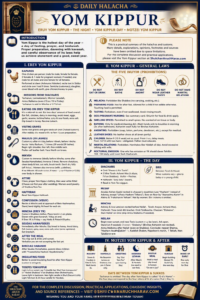
Introduction
Yom Kippur is the holiest day of the year, a day dedicated to repentance, forgiveness, prayer, and reconnecting with Hashem. Its observance begins already on Erev Yom Kippur through Kaparos, charity, festive eating, Mikveh, seeking forgiveness from others, and special preparations for the holy day. It continues through Kol Nidrei, the Five Inuyim, the prayers of Yom Kippur, Neilah, and concludes with Havdalah, the festive Motzei Yom Kippur meal, and preparations for Sukkos.
About This Summary
The following is a brief practical summary of selected laws and customs of Erev Yom Kippur, Yom Kippur, and Motzei Yom Kippur. Due to space limitations, many details, opinions, footnotes, explanations, and source references have been omitted. For the complete discussion, practical applications, Chassidic insights, source references, and full halachic analysis, please see our Sefer on Yom Kippur or visit the Yom Kippur section of https://shulchanaruchharav.com/halacha/yom-kippur
Erev Yom Kippur
Kaparos
- Customarily done before dawn on Erev Yom Kippur.
- How many chickens is a family to use, and what should be the gender of the chicken? One takes a chicken for each family member, a male chicken for a male, a female chicken for a female and two females and one male for a pregnant woman. If one is unable to afford buying one chicken per family member, then one male chicken may be used for all the male members of one’s household and one female chicken may be used for all the female members of one’s household. This applies even in accordance to those which follow the custom to take one chicken per person.
- If a woman used a male chicken or vice versa she fulfills her obligation. The Kaparos is not required to be repeated.
- Maaser money: One may not use Maaser money to perform the Mitzvah of Kaparos. If, however, one cannot afford to buy one chicken per family member, then he can use Maaser money to do so. However even in such a case at least one male and female chicken is not to come from the Maaser funds.
- The color of the chicken: One is to choose a white chicken if they are readily available. However, one is not to specifically search out for a white chicken if it is not readily available.
- What if no chickens are available? If there are no chickens available for Kaparos, then other animals [such as a goose] may also be used for the Kaparos. However young doves and Turim should not be used. Some Poskim rule that fish is valid to be used for Kaparos in the event that poultry is not available. [Today the widespread custom is to use money if chickens are not available. This money is then given to the poor.]
- What is the Kaparos process that is done with the chicken? One holds the chicken and says the paragraph beginning Bnei Adam printed in the Siddur. When one reaches the paragraph of “Zeh Chalifacy” one circles the chicken around his head three times. The above paragraphs beginning from Bnei Adam is then repeated another two times, thus encircling the head a total of nine times.
- When should the ceremony be done? The ceremony is to be performed towards dawn of Erev Yom Kippur [i.e. Ashmuros Haboker]. Kaparos may be performed 1-2 days before Yom Kippur if doing so on Erev Yom Kippur is burdensome on the public or on the Shochtim.
- Covering its blood: It is a Mitzvah for the Shochet to cover the blood of slaughtered fowl with earth or straw. It is permitted to be honored by the Shochet to do so in his place. Before covering the blood one says the blessing of “Al kisoi dam beafar”. Earth or straw is to be set up near the slaughtering area and the Shochet then drips some blood onto it. After the Simanim of the chicken and knife is checked and the chicken is verified as Kosher, one says the blessing and then covers the blood.
- Donating the chicken or its worth to the poor: It is accustomed to donate the chicken itself to paupers. Nevertheless, it is better to redeem the chicken with money and give the money to the poor, as opposed to giving the chicken itself.
- Must one first perform Kaparos on himself prior to performing it on others [i.e. encircling the chicken over the heads of others]? It is proper for one to first perform Kaparos on himself prior to doing so on behalf of others. If there is a reason that he is not able to do so then one may initially do the Kaparos for others before doing so on himself.
- Does it make a difference as to which direction one swerves the chicken around his head? This matter is not discussed in Poskim hence assuming that one may do so in whichever direction he chooses.
- Must one repeat Kaparos if the Shechita of the chicken was a Niveila [invalid]? Yes. If the Shechita was invalid one must redo the Kaparos. If, however, it was a Kosher slaughtering, but the chicken was found to be a Treifa it is nevertheless valid.
- Should the Nusach of Kaparos be said differently by women, or children? Some write Admur intentionally omitted the change of Nuschaos and therefore one should always say “Chalifasi”.
Erev Yom Kippur Davening
Omitted at Shacharis:
- Tachanun
- Lamnatzeiach
- Mizmor Lesodah
- Avinu Malkeinu
The Mitzvah to Eat
- It is a mitzvah to eat on Erev Yom Kippur.
- One should eat generously throughout the day.
- Common customs:
- Fish
- Kreplach
- Bread dipped in honey
- Lekach (honey cake)
Avoid:
- Sesame products
- Excessively spicy foods
- Heavy foods before the fast
Malkus (Symbolic Lashes) on Erev Yom Kippur
- Customarily received after midday, before Mikveh and Mincha.
- Today it is symbolic, serving to awaken a person to Teshuvah, humility, and preparation for Yom Kippur.
- The giver and recipient recite “Vehu Rachum” three times, totaling 39 words, corresponding to the 39 lashes.
- Preferred implement: a calf-leather strap, though special dimensions are not required.
- The recipient kneels, bows the head, and traditionally faces north.
- The purpose is not punishment, but rather heartfelt repentance, submission before Hashem, and spiritual preparation for the Day of Atonement.
Mikveh
- Customary before Mincha.
- Many Chassidim immerse again before Yom Kippur.
- Immerse three times.
- Clean thoroughly and remove any Chatzitzos beforehand.
Mincha of Erev Yom Kippur
- Daven with special concentration.
- Recite Viduy during Mincha.
- Give Tzedakah before Mincha.
- Wear Shabbos/Yom Tov clothing.
Seudas Hamafsekes
- Eat immediately after Mincha.
- Dip bread in honey.
- Eat light foods.
- Avoid overly spicy foods.
- Many eat Kreplach.
One may continue eating and drinking until sunset unless the fast was explicitly accepted earlier.
Birchas Habanim
Before leaving for Kol Nidrei, parents bless their children with:
“Yevarechecha Hashem Veyishmerecha…”
Many use this opportunity to daven for their children’s spiritual and physical success.
Candle Lighting
- Light before sunset.
- Recite:
- Lehadlik Ner Shel Yom Hakippurim
- Followed by Shehechiyanu
- Prepare:
- A 24-hour candle for Havdalah
- Yahrzeit candle when applicable
Yom Kippur
The Five Prohibitions
- Eating and drinking
- Bathing
- Anointing
- Leather footwear
- Marital relations
Melacha
Yom Kippur has the same status as Shabbos regarding Melacha.
Eating & Drinking
- Absolutely forbidden unless medically required.
- One who must eat should consult a Rav regarding Shiurim.
- Pregnant, postpartum, and ill individuals should seek case-by-case guidance.
Bathing
Forbidden for pleasure.
Permitted when:
- Removing dirt
- Medical necessity
- Limited hand washing required for halachic purposes
Morning washing is only until the knuckles.
Anointing
Do not use:
- Perfume
- Cologne
- Lotion
- Deodorant
- Oils
Medical use remains permitted.
Footwear
Leather shoes may not be worn.
Sneakers and non-leather shoes are permitted.
Night of Yom Kippur
Kol Nidrei
- Begins before sunset.
- Recited three times.
- Three Sifrei Torah are removed.
- Everyone should say it quietly together with the Chazan.
Shehechiyanu
Recited before Maariv.
Boruch Shem
Throughout Yom Kippur:
“Boruch Shem Kevod Malchuso Leolam Vaed”
is said aloud.
Yom Kippur Day
Shacharis
- No “Sheasa Li Kol Tzarki.”
- Special Torah reading from Acharei Mos.
- Six aliyos
Musaf
- Recite the Avodah.
- Bow during “Veanachnu Korim.”
- Place a towel or tissue beneath the forehead when required.
Mincha
- Read Parshas Arayos.
- Haftorah of Yonah.
- Begin Neilah on time.
Neilah
Highlights
- Aron remains open throughout Neilah.
- Avinu Malkeinu is recited afterwards.
- Conclude with:
- Shema
- Boruch Shem
- Hashem Hu HaElokim (7 times)
Shofar
One Tekiah is blown at the conclusion of Yom Kippur.
Motzei Yom Kippur
Havdalah
- No Besamim.
- Use a candle that originated from a flame burning before Yom Kippur.
Festive Meal
- Eat a meal over bread.
- Dip bread in honey.
Sukkah
Begin building, planning, or discussing the Sukkah immediately after Yom Kippur.
Gut Yom Tov!
It is customary to greet others with:
“Gut Yom Tov.”
Quick Reference
| Topic | Practical Law |
| Kaparos | Before dawn |
| Mikveh | Before Mincha |
| Tachanun Erev YK | Omitted |
| Eat Erev YK | Mitzvah |
| Mincha | Includes Viduy |
| Final Meal | After Mincha |
| Candle Lighting | Before sunset |
| Five Inuyim | Eating, bathing, anointing, leather shoes, marital relations |
| Kol Nidrei | Before sunset |
| Neilah | Ends near Tzeis |
| Shofar | One Tekiah |
| Havdalah | No Besamim |
| Motzei YK | Festive meal & begin Sukkah |