Introduction
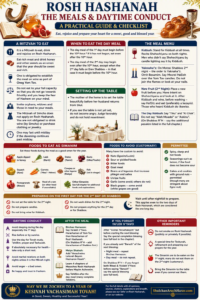
The meals of Rosh Hashanah combine the festivity of Yom Tov with the awe and seriousness of the Day of Judgment. Although Rosh Hashanah is not celebrated with the same unrestrained joy associated with the other festivals, it remains a mitzvah to eat, drink, and honor the day with dignified and festive meals. The foods served are chosen not only for their taste, but also for their symbolism and their ability to awaken prayer, repentance, and hope for a favorable year.
The Rosh Hashanah table is therefore filled with meaningful customs. Round Challahs symbolize Hashem’s coronation and the hope for enduring life. The Challah and apple are dipped in honey as a sign of sweetness. Various Simanim are eaten to inspire prayers for blessing, merit, peace, children, health, and livelihood. At the same time, foods associated with sourness, bitterness, sin, or other unfavorable ideas are customarily avoided.
The conduct surrounding the meal is equally important. One should avoid anger, excessive eating, frivolity, and wasting the sacred hours of the day. The meals should inspire gratitude, trust in Hashem, consideration for the needy, and renewed dedication to Torah, Tehillim, prayer, and Teshuvah.
Important Note
The following chapter is a practical summary of the laws, customs, and Chabad traditions relevant to the Rosh Hashanah meals and daytime conduct. For the full discussion of all opinions, sources, footnotes, explanations, background, practical applications, and halachic analysis, see our Sefer on Rosh Hashanah, Chapter 4, or visit the Rosh Hashanah section of ShulchanAruchHarav.com. All of the laws summarized below are discussed there at length together with their sources and detailed explanations.
- The Mitzvah to Eat on Rosh Hashanah
- It is a mitzvah to eat, drink, and rejoice on Rosh Hashanah. The meals should contain festive foods, rich meat, sweet beverages, honey, and other delicacies as an omen that the coming year should be rich and sweet.
- One should not, however, eat to complete satiation. Overindulgence can lead to frivolous behavior and diminish one’s awareness of the fear of Hashem appropriate for the Day of Judgment.
- Some are particular to avoid goat meat because goats are associated with Gevurah.
- Simcha and Oneg on Rosh Hashanah
- The formal mitzvah of Simchas Yom Tov does not apply to Rosh Hashanah in the same manner as it applies to the other festivals. A person is therefore not obligated specifically because of Simchas Yom Tov to drink wine or purchase clothing or jewelry for one’s wife.
- Nevertheless, the obligation of Oneg Yom Tov applies. Consequently, one should establish the meal over wine and drink wine during the meal, as is customary on Yom Tov.
- Some opinions discourage drinking wine on Rosh Hashanah beyond the wine required for Kiddush. Many Poskim, however, disagree with this restriction.
- Fasting Until Midday
- A person may fast until midday on Rosh Hashanah. This may occur when one has not eaten or drunk before Davening and the prayers continue beyond midday.
- Nevertheless, the meal should not be unnecessarily delayed beyond the appropriate time.
- When to Begin the Day Meal
- The daytime meal of the first day of Rosh Hashanah should begin before the tenth halachic hour of the day.
- If the tenth hour has already passed, the meal should nevertheless be eaten.
- The second day’s meal may generally begin after the tenth hour.
- Inviting Those in Need
- A person must remember the needs of others when celebrating Yom Tov. One should invite or otherwise provide for orphans, widows, and people in need.
- A meal devoted entirely to one’s own pleasure, while ignoring those who lack the means to celebrate, is not considered a proper meal in honor of the mitzvah. The sanctity of the Yom Tov table is expressed not only through what is served, but also through the kindness extended to others.
- Setting the Table
- The table should be set beautifully before Yom Tov in anticipation of the family’s return from Shul.
- If a person returns home and discovers that the table is not ready, the person must not become angry or begin an argument. Anger is always spiritually destructive and is particularly inappropriate on Rosh Hashanah, when one seeks a year of blessing and peace.
- Rather, the person should judge the family favorably, assist where possible, and avoid harboring resentment even privately.
- Kiddush
- The Chabad custom is to stand for Kiddush on both Shabbos and Yom Tov.
- Shehechiyanu is recited during Kiddush on both nights of Rosh Hashanah. Men who did not recite Shehechiyanu at candle lighting recite it during Kiddush.
- When Rosh Hashanah falls on Shabbos, all the appropriate Shabbos additions must be included in Kiddush.
- The day Kiddush: By the day Kiddush of Rosh Hashanah one says the verse Tiku and Ki Chok etc. One does not say Aleh Moadeiy or Askinu. When Rosh Hashanah falls on Shabbos, the following passages are said prior to the verse of Tiku. They are to be said in an undertone: Mizmor Ledavid; Askinu; Veshamru; Im Tashiv; Da Hi; Zechor; Al Kein.
- Yaknahaz on the Second Night
When the second night of Rosh Hashanah falls on Motzei Shabbos, Kiddush follows the order known as Yaknahaz:
- Hagafen
- Kiddush Hayom
- Meorei Haeish
- Havdalah
- Shehechiyanu
The blessing over Besamim is omitted.
The custom is to recite Meorei Haeish over the Yom Tov candles. The flames are not brought together, and one does not hold one’s fingernails toward them. Rather, one simply looks at the candles after reciting the blessing and then continues with the remainder of Yaknahaz.
- The New Fruit on the Second Night
- It is customary to place a new fruit before the person making Kiddush on the second night of Rosh Hashanah. Alternatively, the person may wear a new garment.
- When reciting Shehechiyanu, the person making Kiddush should intend to include both the holiness of the day and the new fruit or garment. The person should look at the fruit while reciting Shehechiyanu.
- Immediately after Kiddush and drinking the wine, but before washing for bread, the blessing of Borei Pri Ha’eitz is recited and the fruit is eaten. The person making Kiddush should not create an unnecessary interruption between Kiddush and eating the fruit.
- The Chabad custom is to eat a Kezayis of the fruit. Other fruits may be combined to form the required amount. If a Kezayis is eaten, the appropriate after-blessing is recited before washing for bread.
- If no new fruit or garment is available, Shehechiyanu is nevertheless recited in Kiddush.
- May a Pomegranate Be Used as the New Fruit?
- A pomegranate should generally not be reserved as the new fruit for the second night because it is customarily eaten as one of the Simanim on the first night.
- Some communities, however, use a pomegranate as the new fruit on the second night.
- Dipping the Challah in Honey
- After reciting Hamotzi, the Challah is dipped into honey three times.
- Salt should nevertheless remain on the table.
- The custom is to dip bread in honey during the Yom Tov and Shabbos meals through Simchas Torah, including Hoshanah Rabbah, Erev Yom Kippur, and Motzei Yom Kippur. This custom is generally not followed during ordinary weekday meals.
- Round Challahs
The ancient Ashkenazic custom is to use round Challahs on Rosh Hashanah.
Several explanations are given:
- The round shape resembles a crown and reflects the coronation of Hashem.
- A circle has no visible beginning or end and symbolizes long life.
- The unified circular shape represents Jewish unity.
Some maintain that the circular shape is used only on Rosh Hashanah itself, while on Shabbos Shuvah one returns to the customary shape resembling two letters Vav.
- The Apple Dipped in Honey
After eating some Challah following Hamotzi, one eats a sweet apple dipped in honey.
The procedure is as follows:
- Recite Borei Pri Ha’eitz over the apple.
- Immediately recite the Yehi Ratzon printed in the Machzor.
- Eat the apple.
When reciting the blessing, one should have in mind all other fruits that will be eaten during the meal, including fruit served as dessert before Birchas Hamazon.
According to Chabad custom, the Yehi Ratzon is recited only over the apple and not over the other Simanim.
- The Symbolism of the Apple
The apple is associated with the “field” or “orchard of apples” discussed in Kabbalah.
An apple provides three forms of benefit:
- Taste
- Aroma
- Appearance
These correspond to three central channels of blessing:
- Children
- Health and life
- Livelihood
Eating the apple on Rosh Hashanah therefore symbolizes a request that these channels of blessing be renewed favorably during the coming year.
- The Symbolism of Honey
- Honey is associated with Gevurah that has been sweetened. It therefore represents the ability to transform severity into kindness and bitterness into sweetness.
- Honey also preserves other foods and can eventually transform certain preserved substances into something resembling honey itself. It therefore symbolizes the spiritual service of Ishapcha, transforming the undesirable into holiness and sweetness.
- The Purpose of the Simanim
- The Simanim are not magical objects and are not eaten as empty superstitions. Their purpose is to remind the person of the blessings needed for the coming year and to inspire heartfelt prayer, repentance, and positive resolutions.
- If a person cannot eat a particular Siman, the item may still be brought to the table and viewed as a favorable sign.
- Which Simanim Are Eaten?
Customary Simanim include:
- Karti, leek
- Silka or Tradin, beets
- Tamri, dates
- Kara, squash
- Rubya, identified differently by various communities
- Carrots, associated in Yiddish with increase
- Apple dipped in honey
- Fish, symbolizing multiplication
- Pomegranate, symbolizing abundant merits
- The head of a ram, recalling the ram of the Akeidah and expressing the wish to be a head rather than a tail
When a ram’s head is unavailable, one may use another appropriate head, such as the head of a fish or chicken. Some suggest eating ram meat when no head is available.
Each community should follow its inherited identification and preparation of the traditional Simanim.
- The Order of the Simanim
- The Chabad custom is to eat the apple dipped in honey first.
- Other communities follow a structured order beginning with dates and continuing with beets, leek, squash, Rubya, pomegranate, the head of a ram, and finally the apple dipped in honey.
- Are the Simanim Eaten on the Second Night?
- Many Poskim rule that the Simanim should also be eaten during the second-night meal.
- Others rule that repeating them is unnecessary. The widespread practice in many communities, including Chabad custom, is to eat the Simanim only on the first night.
- Some Poskim recommend eating the Simanim during the daytime meal as well when they are available. The widespread custom is to emphasize them at the first-night meal.
- Foods Customarily Avoided
Certain foods are avoided because of their taste, symbolism, or physical effect.
These include:
- Nuts
- Sour foods
- Pickled foods
- Bitter foods
- Goat meat
- Certain beans and legumes that increase phlegm and saliva
- Unripe fruit
- Sour fruits
Some avoid garlic, while others are not particular about it.
Some Poskim mention avoiding grapes. This is not the widespread custom, particularly regarding sweet grapes. Some distinguish between black and white grapes or between sour and sweet grapes.
- Using These Foods as Seasoning
- Foods that are customarily avoided may be used as seasonings if they do not cause the completed dish to become noticeably bitter, sour, or pickled.
- For example, lemon may be added to a salad when the result is not considered a sour dish.
- Cakes and Cookies Containing Nuts
- It is permitted to eat cakes, cookies, and similar foods containing ground nuts, even when a slight nut flavor is detectable.
- Nevertheless, many are stringent regarding foods containing the Egoz nut because its numerical value is associated with the word Chet, sin. One who follows this stringency is considered praiseworthy.
- Spicy Foods
- There is no established need to avoid spicy, sharp, or hot foods.
- Accordingly, foods containing chili peppers, Charif, Sechug, or similar seasonings may be eaten.
- Until When Are These Foods Avoided?
- Some have a custom to avoid nuts until after Simchas Torah.
- Many extend the avoidance of the other listed foods throughout this period as well. Each family should follow its accepted custom.
- Avoiding Anger
- One must be exceptionally careful not to become angry on Rosh Hashanah.
- Aside from the general severity of anger, becoming angry on Rosh Hashanah is considered an unfavorable omen for the coming year. Even where a genuine inconvenience occurs, one should respond with patience, favorable judgment, and self-control.
- Happiness and Trust in Hashem
- One should be calm, positive, and appropriately joyful on Rosh Hashanah.
- This happiness should not lead to frivolity. Rather, it should express trust that Hashem will accept one’s Teshuvah, prayers, and good deeds and grant a sweet and blessed year.
- Smoking
- Those who smoke during the year, including on other festivals, customarily refrain from smoking on Rosh Hashanah.
- The practice applies even in private. Torah scholars and community leaders should encourage others to follow this restriction.
- Birchas Hamazon
Yaaleh Veyavo is recited in Birchas Hamazon.
In the Harachaman section, one recites:
- The Harachaman for Yom Tov
- The Harachaman for Rosh Hashanah
When Rosh Hashanah falls on Shabbos, the order is:
- Harachaman for Shabbos
- Harachaman for Yom Tov
- Harachaman for Rosh Hashanah
- If Yaaleh Veyavo Was Forgotten
- If Yaaleh Veyavo was forgotten during the night meal and the person already began the fourth blessing, Birchas Hamazon must be repeated.
- If it was forgotten during the daytime meal, Birchas Hamazon is not repeated.
- If the omission is remembered after completing Uvinei Yerushalayim but before beginning Baruch of the fourth blessing, the special corrective blessing for Rosh Hashanah is recited.
- When Rosh Hashanah falls on Shabbos, both Retzei and Yaaleh Veyavo must be included. If one or both were omitted, the appropriate corrective blessing or repetition depends upon where the person remembered the omission.
- Me’ein Shalosh
The following addition is recited in the after-blessing of Me’ein Shalosh:
Vezachreinu Letovah Beyom Hazikaron Hazeh.
- Learning Maseches Rosh Hashanah
- Based on Kabbalah, one should study the four chapters of Maseches Rosh Hashanah before Mayim Acharonim at each of the night and daytime meals.
- Each chapter corresponds to one letter of the Divine name Havayah.
- Tehillim and Torah Study After the Meal
- After the daytime meal, one should return to Shul and recite Tehillim.
- Some have the custom to complete the entire Sefer Tehillim. Others recite it together with a Minyan without interruption.
- The Rebbe Rashab would maintain all his established Torah study sessions on Rosh Hashanah and Yom Kippur, including his studies in Nigleh.
- Sleeping During the Day
- One should avoid sleeping during the daytime of Rosh Hashanah, including after midday.
- Some permit or customarily take a rest after midday. Practically, it is preferable to avoid sleeping on the first day even after midday, while there is somewhat greater room for leniency on the second day.
- From a spiritual perspective, the hours of both days should be devoted to Tehillim, Torah study, prayer, and service of Hashem.
- Sleeping Past Dawn or Sunrise
- One should endeavor to awaken before Alos Hashachar and not return to sleep during the daytime.
- Particular care should be taken not to sleep through the first hour of the day, when Hashem judges the world.
- Many are lenient to remain asleep after Alos based on the view that the relevant first hour begins at sunrise. Nevertheless, one should certainly avoid sleeping past sunrise.
- A person who is unwell should make an effort to rise in the morning and, if necessary, rest later in the day.
- Sleeping for Health or Strength
- A person who genuinely needs sleep to function may rest briefly.
- Even in such a case, it is preferable to delay sleeping until after midday where possible. This includes a person suffering from a headache, migraine, or similar difficulty.
- The issue is not sleep alone. The purpose is to avoid wasting the sacred hours of Rosh Hashanah. A person who remains awake but does not use the time for Torah, prayer, Tehillim, or constructive spiritual activity does not achieve the purpose of the custom.
- Preparing for the Second Day
One may not prepare on the first day of Rosh Hashanah for the second night or day.
This prohibition applies even though the two days of Rosh Hashanah are treated in certain respects as one extended sanctity. It also applies when an Eiruv Tavshilin was made.
Accordingly, before nightfall one may not:
- Set the table for the second night
- Prepare the candles
- Bring wine specifically for second-night Kiddush
- Wash dishes solely for the second night
- Search in the Sefer Torah for the following day’s reading
- Perform another act solely to prepare for the second day
All such preparations must wait until after nightfall.
If Shabbos follows the second day, preparations for Shabbos are performed on the second day in accordance with the Eiruv Tavshilin. One may not prepare for Shabbos on the first day.
Two-Sentence Summary
It is a mitzvah to eat, drink, and conduct dignified festive meals on Rosh Hashanah, while avoiding excessive indulgence and maintaining awareness of the sanctity and judgment of the day. The meals include symbolic foods and customs intended to arouse prayer and hope for a sweet year, while the remainder of the day should be devoted to Torah, Tehillim, prayer, and spiritual preparation.
Quick Reference Table
| Topic | Practical ruling |
| Festive meals | It is a mitzvah to eat and drink |
| Overeating | Avoid complete satiation and frivolity |
| Wine | Drink during the meal for Oneg |
| Guests in need | Invite or provide for them |
| Table setting | Prepare beautifully and avoid anger |
| Challah | Use round Challahs and dip in honey |
| Apple and honey | Eat after Hamotzi with the Yehi Ratzon |
| Simanim | Customarily eaten on the first night |
| New fruit | Place before Kiddush on the second night |
| Nuts | Customarily avoided |
| Sour and bitter foods | Customarily avoided |
| Garlic | Subject to custom |
| Spicy foods | Permitted |
| Nut cake and cookies | Generally permitted |
| Anger | Must be carefully avoided |
| Sleeping during the day | Preferably avoided |
| Tehillim after the meal | Proper and customary |
| Preparing for the second day | Wait until nightfall |
| Yaaleh Veyavo at night | If fully omitted, Birchas Hamazon is repeated |
| Yaaleh Veyavo by day | Birchas Hamazon is not repeated |
Practical Examples
Example 1: The Table Is Not Ready
A person returns from Shul and discovers that the table has not been completely set. Rather than becoming upset, the person should judge the family favorably and help complete the preparations.
Example 2: The Apple and Other Fruit
A person plans to eat an apple dipped in honey, dates, and pomegranate. When reciting Borei Pri Ha’eitz over the apple, the person should intend to include the other fruits.
Example 3: No New Fruit Is Available
A family has no new fruit or new garment for the second night. Shehechiyanu is nevertheless recited during Kiddush.
Example 4: Cake Containing Ground Nuts
A cake contains ground nuts as part of its mixture. It may be eaten, although those who avoid every food containing Egoz may continue their stringency.
Example 5: Lemon in a Salad
Lemon juice is added as a seasoning, but the salad does not become distinctly sour. The salad may be eaten.
Example 6: A Needed Afternoon Rest
A person has a significant headache and cannot concentrate on prayer or Tehillim. A brief rest may be taken when genuinely necessary, although resting after midday is preferable where possible.
Example 7: Preparing the Second-Night Table
A person wants to set the table during the first afternoon to save time. The table may not be set specifically for the second night until after nightfall.
Example 8: Washing Dishes
The dishes used during the first day will not be needed again until the second night. They may not be washed solely for the following meal before nightfall.
Example 9: Yaaleh Veyavo Was Forgotten at Night
A person finishes the night meal, completes Birchas Hamazon, and then remembers that Yaaleh Veyavo was omitted. Birchas Hamazon must be repeated.
Example 10: Yaaleh Veyavo Was Forgotten by Day
A person remembers after completing Birchas Hamazon at the daytime meal that Yaaleh Veyavo was omitted. Birchas Hamazon is not repeated.
Conclusion
The Rosh Hashanah meals are intended to nourish both body and soul. Festive foods, honey, round Challahs, and the Simanim express confidence in Hashem’s kindness, while moderation, generosity, careful speech, and the avoidance of anger preserve the fear and dignity of the Day of Judgment.
The hours following the meal should not be treated as ordinary leisure time. They should be used for Tehillim, Torah study, prayer, kindness, and serious preparation for a favorable judgment and a sweet new year.