Introduction
Selichos marks the opening of the final preparations for the Days of Judgment. During these sacred days, Jews gather to beseech Hashem for forgiveness, mercy, and a favorable judgment for the coming year. The customs and laws of Selichos are numerous and include specific guidelines regarding when Selichos should be recited, the proper frame of mind, the recital of the Thirteen Attributes of Mercy, the role of the Chazan, and the laws that apply when one is reciting Selichos without a Minyan. Particularly significant is the first night of Selichos, which always begins on Motzei Shabbos. Chabad custom places special emphasis on preparation, including learning Torah, giving charity, participating in a Farbrengen, and reciting Selichos with seriousness, concentration, and heartfelt supplication.
Quick Selichos Checklist
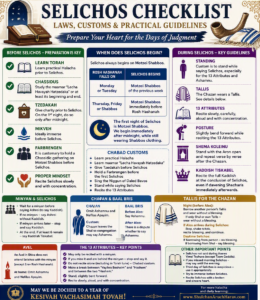
| ✅ Before Selichos | Practical Guidance |
| Torah study | Learn practical Halacha prior to Selichos. |
| Chassidus | Study the maamar Lecha Hashem Hatzedakah before Selichos. |
| Tzedakah | Give charity before Selichos. On the first night, do so only after midnight. |
| Mikveh | Men Ideally immerse before Selichos of Shacharis. |
| Farbrengen | It is customary to hold a Chassidic gathering before the first Selichos. |
| Proper mindset | Recite Selichos slowly and with concentration. |
| ✅ During Selichos | Practical Guidance |
| Standing | Custom is to stand during Selichos, especially for the 13 Middos and Ashamnu. |
| Tallis | The Chazan wears a Tallis. |
| 13 Attributes | Recite carefully, aloud, and with concentration. |
| Posture | Slightly bend forward while reciting the 13 Attributes. |
| Shema Koleinu | Stand with the Aron open and repeat after the Chazan. |
| Kaddish | Recite Kaddish Tiskabel at the conclusion. |
When Does Selichos Begin?
- Selichos always begins on a Motzei Shabbos.
- Since at least four days of Selichos are required before Rosh Hashanah, the starting date depends on the day of the week on which Rosh Hashanah falls:
| Rosh Hashanah Falls On | Selichos Begins |
| Monday or Tuesday | Motzei Shabbos of the previous week |
| Thursday, Friday or Shabbos | Motzei Shabbos immediately before Rosh Hashanah |
The Chabad custom is to begin Selichos immediately after halachic midnight on Motzei Shabbos.
The First Night of Selichos
The first Selichos possesses unique significance.
On Motzei Shabbos:
- Selichos is recited immediately after midnight.
- One remains dressed in Shabbos clothing.
- It is customary to hold a Farbrengen before Selichos.
- The maamar Lecha Hashem Hatzedakah should be studied before midnight.
- Charity is given after midnight and before Selichos.
Many Chassidim viewed the first Selichos as a special spiritual event and prepared for it with extra seriousness and introspection.
The Proper Time for Selichos
- The preferred time for Selichos is during Ashmuras Haboker, the final portion of the night.
- Practically, the widespread custom today is to recite Selichos before Shacharis.
- According to Kabbalah, Selichos should not be recited before midnight.
- If one missed the morning recital, Selichos may be recited throughout the day until evening.
The Importance of Concentration
- Selichos should never be rushed.
- It is preferable to recite fewer passages with concentration than to recite all of Selichos mechanically and without feeling.
- Many authorities strongly criticize those who hasten through the closing portions of Selichos.
- The entire purpose of Selichos is heartfelt prayer, reflection, and repentance.
The Thirteen Attributes of Mercy
How They Should Be Recited
The Thirteen Attributes must be recited:
- Slowly
- Carefully
- Aloud
- With concentration
One is to make a pause between:
- Vayikra Besheim and Hashem
- The first and second Hashem
Many have the custom to count the attributes on their fingers or visualize each word while reciting them.
Physical Posture
The custom is:
- To stand
- Not to lean
- To slightly bend forward
An elderly or weak person may lean if necessary.
Reciting the 13 Attributes Without a Minyan
The Thirteen Attributes may only be recited with a Minyan.
When saying Selichos without a Minyan:
❌ The 13 Attributes are omitted.
❌ The words beginning from Vayaavor are omitted.
❌ The Aramaic sections are omitted.
✅ The verse Uzechor Hayom Bris Shlosh Esrei is still recited.
The accepted Chabad custom is not to recite the 13 Attributes alone even in the Torah-reading melody.
The Chazan and the Tallis
- The Chazan should wear a Tallis while leading Selichos.
- This applies even if the Chazan is unmarried.
Nighttime Selichos
When Selichos is said before the time a Tallis may receive a blessing:
- The Chazan should borrow another person’s Tallis.
- It should be worn without a blessing.
If only the Shul Tallis or his own Tallis is available:
- It is worn without a blessing.
If dawn arrives during Selichos:
- The Chazan should stop,
- Shake the Tzitzis,
- Recite the blessing,
- And continue.
The Order of Selichos
The Chabad Nusach was arranged by the Rebbe based upon directives of the Frierdiker Rebbe.
The structure follows the general pattern of prayer:
- Ashrei
- Half Kaddish
- Selichos
- Shema Koleinu
- Kaddish Tiskabel
It is not the Chabad custom to perform Nefilas Apayim during Selichos.
A Minyan for Selichos
- The congregation should ideally wait until a Minyan is assembled before beginning Ashrei.
- If no Minyan is present, Ashrei may be said without Kaddish.
If a Minyan arrives in the middle of Selichos:
- The congregation should stop and say Kaddish.
If ten people began together and less than ten remain at the conclusion:
- Kaddish Tiskabel may still be recited if at least six remain.
Chabad Customs of Selichos
Some special Chabad customs include:
- Learning practical Halacha before Selichos.
- Learning the maamar Lecha Hashem Hatzedakah.
- Giving Tzedakah before Selichos.
- Holding a Farbrengen before the first Selichos.
- Singing the Niggun of Daled Bavos during the days of Selichos.
- Standing for Selichos whenever possible.
- Reciting the Thirteen Attributes with special concentration.
Chasan and Baal Bris and Avel
Chasan
If a Chasan is present:
- Ashamnu is omitted.
- Nefilas Apayim is omitted.
Practically, the accepted custom is often for the Chasan to leave temporarily so that the congregation may recite Ashamnu.
Baal Bris
If Selichos is said before Alos:
- Ashamnu is recited.
If Selichos is recited after Alos:
- There is a dispute regarding whether Ashamnu is recited.
The remainder of Selichos is recited according to all opinions.
Avel
An Avel during Shiva does not leave the home to attend Selichos with the congregation.
The exception is Erev Rosh Hashanah.
When Selichos is recited in a house of mourning:
- Ashamnu is omitted.
- Nefilas Apayim is omitted.
Summary
Selichos is a time of preparation, introspection, and heartfelt prayer before the Days of Judgment. The first Selichos begins on Motzei Shabbos immediately after midnight and is preceded by Torah study, Tzedakah, and often a Farbrengen. Selichos should be recited slowly, with concentration and humility, with special care given to the recitation of the Thirteen Attributes of Mercy. The Chazan should wear a Tallis, the congregation should strive to recite Selichos with a Minyan, and all should utilize these precious days as a time of genuine repentance and spiritual preparation for Rosh Hashanah.