Introduction
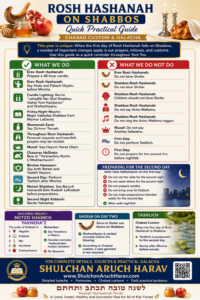
When Rosh Hashanah coincides with Shabbos, a number of changes are made to the regular order of prayers, mitzvos, Kiddush, candle lighting, and other observances. Some practices are omitted entirely, most notably the blowing of the Shofar and the recitation of Avinu Malkeinu, while other customs are modified to reflect both the sanctity of Shabbos and the holiness of Rosh Hashanah.
The following chapter presents the practical halachos and Chabad customs that apply when the first day of Rosh Hashanah falls on Shabbos, together with the laws that become relevant on the second day when it falls on Motzei Shabbos.
Quick Reference Table
| Topic | Practical Law |
| Erev Rosh Hashanah | Shofar is not blown |
| Candle lighting | Recite “Lehadlik Ner Shel Shabbos Vishel Yom Hazikaron” and Shehechiyanu |
| Kabbalas Shabbos | Begin from Mizmor LeDavid |
| Avinu Malkeinu | Omitted on Shabbos |
| Shofar | Not blown on Shabbos |
| Tashlich | Deferred to the second day |
| Hayom Haras Olam | Recited even without shofar blowing |
| Areshes Sefaseinu | Omitted |
| Kiddush Friday night | Includes all Shabbos additions |
| Birchas Hamazon | Recite both Retzei and Yaaleh Veyavo |
| Tzidkascha at Mincha | Omitted |
| Preparations for second day | Forbidden until nightfall |
| Second-night Kiddush | Yaknehaz |
| Havdalah formula | Bein Kodesh LeKodesh |
| New garment for Shofar second day | Not required |
- Erev Rosh Hashanah Which Falls on Friday
Blowing Shofar Erev Shabbos:[1] When Erev Rosh Hashanah falls on Erev Shabbos, the usual custom of refraining from shofar blowing remains in effect.[2] No shofar may be blown publicly during the entire day of Erev Rosh Hashanah, even when Rosh Hashanah itself will occur on Shabbos. One who needs to practice may do so only in a private room.
Mincha Erev Rosh Hashanah:[3] Before Mincha, one recites Hodu and Patach Eliyahu as is customary every Erev Shabbos. This differs from a regular Erev Rosh Hashanah, when these passages are generally omitted.
Candle lighting:[4] For candle lighting, the blessing includes both Shabbos and Rosh Hashanah: “…Lehadlik Ner Shel Shabbos Vishel Yom Hazikaron.” Afterwards, the blessing of Shehechiyanu is recited.
48-hour candle: A 48-hour candle should be prepared before Shabbos to provide a pre-existing flame for the second night of Yom Tov. Anyone observing a Yahrtzeit on Rosh Hashanah should likewise light the Yahrtzeit candle before Shabbos begins.
- General Prayer Laws
Crying on Rosh Hashanah that falls on Shabbos:[5] The Arizal taught that tears shed during the prayers of Rosh Hashanah and Yom Kippur are an expression of a soul’s deep connection to Hashem. Accordingly, one may cry during the prayers even when Rosh Hashanah falls on Shabbos.
May one pray for physical matters on Rosh Hashanah that falls on Shabbos?[6] Although requests for personal needs are generally limited on Shabbos, one may pray for both spiritual and physical needs on Rosh Hashanah, since it is a day of judgment and supplication.[7]
Avinu Malkeinu recital:[8] Avinu Malkeinu is omitted entirely on Shabbos Rosh Hashanah.[9]
Avinu Malkeinu singing:[10] The Chabad custom is to sing the melody of Avinu Malkeinu before the prayers of Rosh Hashanah. However, when Rosh Hashanah falls on Shabbos, the melody is not sung.
- Friday Night Maariv[11]
- When the first night of Rosh Hashanah falls on Friday night, Kabbalas Shabbos begins with Mizmor LeDavid, omitting the earlier psalms beginning with Lechu Neranena.[12]
- In Lecha Dodi the normal dialect of Berina is recited.[13]
- The remainder of Kabbalas Shabbos is recited as usual, including Lecha Dodi, Mizmor Shir, and Kegavna.
- Following Shemoneh Esrei, Vayechulu and Mei’ein Sheva are recited. In the blessing of Mei’ein Sheva, the Chazan says HaMelech HaKadosh instead of HaKeil HaKadosh, but still concludes with Mekadesh HaShabbos.
- If in Meiyn Sheva the Chazan said Hakeil Hakadosh instead of Hamelech Hakadosh the Chazan is not to repeat the blessing.[14]
- Following the recital of Meiyn Sheva one recites Ledavid Mizmor and then Kaddish with Tiskabel. This Kaddish is then followed by “Mizmor Ledavid Hashem Roiy” as is usually recited on Friday night.[15] One then recites half Kaddish, Barchu and Aleinu.[16]
- Changes in Shemoneh Esrei
- When Rosh Hashanah falls on Shabbos, the phrase Zichron Teruah is substituted in place of the phrase Yom Teruah, since the shofar is not physically blown.[17] If one mistakenly says the alternate version, he nevertheless fulfills his obligation and does not repeat the prayer.
- Throughout Shemoneh Esrei, Shabbos must be mentioned together with the Yom Tov references.[18] If he did not mention Shabbos at all in the middle blessing he does not fulfill his obligation [and is to follow the order explained above by Mikadesh Yisrael Vehazmanim]. If he mentioned Shabbos either in the middle of the blessing or in the concluding blessing of “Mikadesh Hashabbos Yisrael…” then he fulfills his obligation. The same law applies regarding if he concluded only with Mikadesh Hashabbos and did not mention Mikadesh Yisrael etc.[19]
- Shofar on Shabbos[20]
- The Sages decreed that the shofar is not blown when Rosh Hashanah falls on Shabbos. Although blowing shofar is not inherently a forbidden Shabbos activity, the Rabbis feared that someone might carry the shofar through a public domain in order to learn how to blow it. Accordingly, no one may blow shofar on Shabbos Rosh Hashanah.
- Children are likewise not permitted to blow shofar on this Shabbos, even for practice, and they should be stopped if they do so.[21]
- The shofar is treated as muktzah and may only be moved when one requires either its place or a permitted use of the object.[22]
- Shacharis
- Avinu Malkeinu is omitted entirely on Shabbos Rosh Hashanah.
- The passage of Hashem Hashem is nevertheless recited three times before Berich Shemei when the Torah is removed.[23]
- Since the day possesses the sanctity of Shabbos, seven aliyos are called to the Torah.
- Regarding a Mi Shebeirach for the sick, there are differing customs concerning whether to include the words “Shabbos Hi Milizok.”[24]
- If a Bris Milah takes place on Shabbos Rosh Hashanah, the accepted custom is to perform it before Ashrei.[25]
- Musaf
- The paragraph Hayom Haras Olam is recited during Musaf just as on every Rosh Hashanah.[26]
- However, since the shofar is not blown, the paragraph Areshes Sefaseinu is omitted.[27]
- During Aleinu in the Chazan’s repetition, the custom of bowing and prostrating oneself remains in effect even though it is Shabbos.[28]
- Friday Night Kiddush
- Friday night Kiddush includes all the additions for both Shabbos and Rosh Hashanah.
- Vayechulu is recited before Kiddush.[29]
- The concluding bracha is: Mekadesh HaShabbos VeYisrael VeYom Hazikaron
- If one completely omitted the Shabbos component from Kiddush, Kiddush must generally be repeated.[30]
- Birchas Hamazon
- One recites both Retzei and Yaaleh Veyavo.
- When reaching the Harachaman section, one first says the special Harachaman for Shabbos, then the Harachaman for Yom Tov, followed by the Harachaman for Rosh Hashanah.[31]
- If either Retzei or Yaaleh Veyavo is forgotten, the detailed laws of repetition and corrective blessings apply.[32]
- Mincha
- At Mincha, the paragraph VaAni Sefilasi is recited as on every Shabbos.[33]
- The Chabad custom is to omit Tzidkascha Tzedek when the first day of Rosh Hashanah falls on Shabbos.[34]
- Tashlich[35]
Although some authorities allow Tashlich on Shabbos, the accepted Chabad custom is not to recite Tashlich on the first day when it falls on Shabbos. Instead, Tashlich is postponed until the second day of Rosh Hashanah and is recited after Mincha before sunset.
- Preparing for the Second Day[36]
It is forbidden to perform any preparations on the first day of Yom Tov for the benefit of the second day. Therefore, one may not:
- Set the table for the second night.
- Wash dishes for the second night.
- Prepare candles.
- Bring wine for second-night Kiddush.
- Make other visible preparations.
All such preparations must wait until after nightfall.
- The Second Day When It Falls on Motzei Shabbos
- After Shabbos ends, one may not perform any Yom Tov activity until saying: Baruch Hamavdil Bein Kodesh LeKodesh or reciting Maariv with Vatodieinu.[37]
- Women should likewise say Baruch Hamavdil before lighting candles or making Yom Tov preparations.
- The candles for the second night are lit only after nightfall.[38]
- Maariv-Vetodieinu:[39]
When [the second night[40] of] Rosh Hashanah falls on Motzei Shabbos [i.e. Saturday night], then in the evening prayer of Shemoneh Esrei the paragraph of Vetodieinu/ותודיענו is added prior to the paragraph of ותתן לנו, after the paragraph of Ata Vechartanu.[41]
- Yaknehaz[42]
When the second day of Rosh Hashanah falls on Motzei Shabbos, Kiddush follows the order known as Yaknehaz:
- Hagafen
- Kiddush
- Ner
- Havdalah
- Shehechiyanu
- The blessing of Besamim is omitted.
- The blessing over fire is recited while looking at the Yom Tov candles, without joining the flames together and without examining one’s fingernails.
- The Havdalah concludes with: HaMavdil Bein Kodesh LeKodesh
- Shofar on the Second Day
Since no shofar was blown on the first day, the second day’s blowing serves as the first practical fulfillment of the mitzvah. Therefore, there is no need for the Baal Tokeia to wear a new garment when reciting Shehechiyanu before blowing the shofar. The blessing is recited in the standard fashion without that concern.
Conclusion
When Rosh Hashanah falls on Shabbos, the observance of the day combines the holiness of Shabbos with the awe and judgment of Rosh Hashanah. The most noticeable changes are the omission of shofar blowing, the omission of Avinu Malkeinu, the postponement of Tashlich to the second day, and the inclusion of all Shabbos additions in the prayers, Kiddush, and Birchas Hamazon. On the second night, when it falls on Motzei Shabbos, one follows the special order of Yaknehaz and may begin preparations only after Shabbos has completely ended.
[1] M”B 581:24; Kaf Hachaim 581:77
[2] The reason: As by reciting the words “Zichron Teruah” on Shabbos it is considered as if the Shofar was blown. This especially applies due to the fact that in the Mikdash the Shofar was blown. [ibid]
[3] Shaar Hakolel 17:2; Shevach Hamoadim p. 14; Otzer Minhagei Chabad p. 55
Other Opinions: Some are accustomed not to recite Hodu before Mincha of Erev Rosh Hashanah even if it coincides with Erev Shabbos. [Darkei Chaim Veshalom 704; See Shulchan Hatahor 262:12]
[4] Siddur Tehillas Hashem; Sefer Haminhagim p. 117 [English]
[5] Mateh Efraim 582:28; implication of Shaar Hakavanos 90a; brought in Kaf Hachaim 582:60
[6] Mateh Efraim 584:25 [regarding an ill person]; Az Nidbaru 14:21; Piskeiy Teshuvos 582:7
[7] Although asking for one’s physical needs is ordinarily forbidden on Shabbos and Yom Tov [See Admur 294:1; 299:15; 188:4; 584:5] nevertheless it is permitted to do so on Rosh Hashanah being that this day was established to be a day of judgment which requires prayer and supplication. [ibid] Vetzaruch Iyun from the ruling in 584:5 regarding Avinu Malkeinu, that it is omitted on Rosh Hashanah due to Bakashas Tzerachav! Some suggest that only a set prayer of request was negated on Shabbos Rosh Hashanah while a private request is not only allowed but is motivated to be done. [Piskeiy Teshuvos 582 footnote 21]
Where in Shmoneh Esrei are the requests to be made? The requests are to be made after the first Yehiyu Leratzon but prior to reciting the second Yehiyu Leratzon. [See Admur 122:1; M”B 12:3]
[8] 584:5; 602:2; Rama 584:1; 602:1; Rivash 512; Kneses Hagedola 584:2; Peri Chadash; Kisei Eliyahu 584:3
Other opinions: Many Poskim rule that Avinu Malkeinu is to be recited even on Shabbos. [Rashbatz 3:186 brought in Beis Yosef; Hatanya; Mateh Yehuda 584; implication of Arizal in Shaar Hakavanos; see Kaf Hachaim 584:8] Based on the Arizal ibid it appears that one is to recite all the stanzas of Avinu Malkeinu, with exception to the one’s that mention sin, even on Shabbos Shuva, and so is the custom of the Beis Keil community in Jerusalem. [Kaf Hachaim 582:16] The Kaf Hachaim 584:8 concludes: It seems that the Ashkenazi custom is to omit it while the Sephardic custom is to say it and for this reason the Michaber omitted this ruling from his Shulchan Aruch. Each community is to follow their custom.
[9] The reason: As it is forbidden to request one’s needs on Shabbos. [ibid; Ran] Alternatively the reason we omit it on Shabbos is because the entire reason that we recite Avinu Malkeinu is in correspondence to the middle blessings of Shemoneh Esrei that are omitted on Rosh Hashanah during the week. [Levush brought in Kaf Hachaim 584:7]
Does this also apply to private requests? Some suggest that only a set prayer of request was negated on Shabbos Rosh Hashanah while a private request is not only allowed but is motivated to be expressed. [Piskeiy Teshuvos 582 footnote 21]
[10] Orchos Menachem p. 68-69; While there is no Halachic prohibition against doing so, the Rebbe was accustomed not to sing get on Shabbos even when Rosh Hashanah fell on Shabbos, and he likewise motioned for the Chassidim not to sing it.
[11] Siddur Admur regarding Yom Tov; Ketzos Hashulchan 77:2; Shaar Hakolel 17:6 states that this was mistakenly omitted from certain prints of the Siddur
Ruling of Admur in Shulchan Aruch: In the Shulchan Aruch 619:10, Admur rules that Kabalas Shabbos is not recited, although Mizmor Shir Leyom Hashabbos is recited before Barchu. So also brings M”E 625:41 as the customs of some communities. In the Siddur, however, Admur rules to begin from Mizmor Ledavid, and so is the Chabad custom.
[12] The reason: Some write the reason is because there is a Mitzvah of Simcha on Yom Tov and we hence desire to speed the conclusion of Maariv. [Otzer Minhagei Yeshurun p. 64; See Admur 270:1 regarding Bameh Madlikin that it is omitted on Yom Tov in order to hasten Simchas Yom Tov] Alternatively the reason is because these Psalms contain the words Rina, and on Yom Tov we emphasize the words Simcha. [Ketzos Hashulchan 77 footnote 13] Alternatively the reason is because the first five Mizmorim until Mizmor Ledavid relate to the five weekdays until Erev Shabbos while the psalm of Mizmor Ledavid relates to Erev Shabbos. Hence, we omit the first five Zemiros as it is not proper to relate them to Yom Tov. [Sichas Kodesh 2 p. 121] To note that the Mitzvah of Simcha does not apply on Rosh Hashanah, and hence we recite Berina in Lecha Dodi as a normal Shabbos, thus the only reason that explains why on Rosh Hashanah we omit these Psalms is the last reason mentioned. [Glosses of Rav Raskin on Siddur p. 250]
[13] Sefer Haminhagim p. 52 [English]; Rebbe in Machzor Chabad; Luach Kolel Chabad [Edited]; Implication of instructions in Siddur Yaavetz; M”E 582:2; See Otzer Minhagei Chabad p. 62; Glosses of Rav Raskin on the Siddur
The reason: The Rebbe [in a footnote on the Machzor ibid] explains that Rosh Hashanah and Yom Kippur are not given for days of rejoicing [see Admur 582:10] and hence we do not change from the normal wording of Berina.
Other Yomim Tovim: By other Yomim Tovim the custom is to interchange the word Berina for Besimcha. [Hagahos Hasiddur of Rebbe Rashab; Ketzos Hashulchan 77:2; Mishnes Chassidim “Leil Yom Tov” 1:2].
Difference between Rina and Simcha: The term Rina denotes a bittersweet joy, a joy that comes as a result of a previous distance. However, Simcha does not have any bitterness mixed with it at all. [Magen Avos Vayishlach’ Ketzos Hashulchan 77 footnote 13] Accordingly it is understood why on Rosh Hashanah we do not recite Besimcha, as there is bitterness involved in the repentance required.
Other customs: Some are accustomed to reciting Besimcha even on Rosh Hashanah. [Minhag Rav Ahron of Belz, brought in Piskeiy Teshuvos 582 footnote 20]
[14] See Kaf Hachaim 582:18; Mateh Efraim 582:5; Alef Lamateh 582:1; Alef Hamagen 582:17; Piskeiy Teshuvos 582:6
[15] Mateh Efraim 582:2; Otzer Minhagei Chabad p. 63
[16] The above order is written in Piskeiy Hasiddur footnote 40; Otzer Minhagei Chabad p. 69
[17] Admur 582:9; Michaber 582:7
[18] Admur 487:3
[19] A dispute on this matter is recorded in Admur: Some Poskim rule if one forgot to mention either Shabbos or Yom Tov by the concluding blessing, he does not fulfill his obligation. However others say that it is similar to saying a weekday prayer on Shabbos:Yom Tov, in which case if one said Yaleh Veyavo, then he fulfills his obligation, thus so too here, if one mentioned Shabbos:Yom Tov in the middle of the blessing, then one has fulfilled his obligation even if he does not mention it by the concluding blessing. Admur concludes that it is proper to suspect for the latter opinion and not repeat the blessing, in order not to enter oneself into a doubt of saying a blessing in vain. [ibid]
[20] Admur 588:4; Michaber 588:5; Mishneh Rosh Hashanah 29b
[21] Admur 588:6; 343:1 as explained in background
Background from 343:1: In 343:1 Admur rules that if one who sees a child under the age of Bar or Bas Mitzvah transgressing a prohibition one does not need to reprimand or stop the child from doing so, if the child is doing so for his own benefit, such as eating Treif foods or desecrating Shabbos for his own needs. Furthermore, even a Rabbinical court does not have the requirement to stop or reprimand him. However in a case that the transgression of the child will become public knowledge and there is suspicion that this may lead people to mistakenly think that what the child has done is in truth permitted being that no one protested, then the Beis Din is obligated to protest their actions even if they are doing so for their own benefit. For example, if the child was blowing Shofar on Shabbos Rosh Hashanah then since people hearing the Shofar may think that one is indeed meant to blow even on Shabbos Rosh Hashanah, therefore the child is to be reprimanded. [Admur ibid]
[22] Admur 588:5; See also: Admur 308:20; Rama 308:4; Hgahos Ashri 2:24
Other Opinions: Some Poskim rule that in today’s time a Shofar is considered MMC”K. [Piskeiy Teshuvos 308:8; 588:2] Vetzaruch Iyun as what changed in this regard between then and now.
[23] Siddur Admur
[24] Mateh Efraim 584:25
[25] Yaavetz in Siddur; Derech Hachaim; Mateh Efraim 584:26; M”B 584:12
[26] Admur 592:6; Rama 592:1; Rashbatz 3:290 and 309; Birkeiy Yosef 591:5; Shaareiy Teshuvah 591:6; Machzor Chabad
[27] Admur ibid; Rama ibid; Machzor Chabad
[28] Machzor Chabad; See Otzer Minhagei Chabad 323
Other customs: The custom on many communities is not to bow or prostrate during Aleinu on R”H or Yom Kippur that coincides with Shabbos. [Ashel Avraham Butchach 621:4; Hagahos Chochmas Shlomo 592; See Divrei Yatziv 2:265]
[29] Admur 473:5; Michaber 473:1
[30] See Admur 487:3; M”B 487:2; Piskeiy Teshuvos 473:2; 487:4
[31] Piskeiy Teshuvos 597:1; See P”M 490 A”A 1
[32] Siddur
[33] Sefer Haminhagim p. 133 [English]; Levush 598; Mateh Efraim 598:3; See Otzer Minhagei Chabad p. 140
[34] 598:1
Background:
Although when a regular Yom Tov falls on Shabbos we omit Tzidkascha by Mincha, nevertheless on R”H that falls on Shabbos we say Tzidkascha being that it is a day of judgment and it is proper to say “Tziduk Hadin” on the day of judgment, and so is the custom of Sefardic Jewry. [Tur; Beis Yosef; Michaber 598:1] However there are opinions [Rama 597:1; Ran; Minhagim] that rule that even on R”H that falls on Shabbos one is to omit Tzidkascha being the verse states “Mishpatecha Tehom Raba” and one is to avoid arousing judgment on the day of judgment. Furthermore, this day is Rosh Chodesh and one does not say Tzidkascha on Rosh Chodesh as explained in chapter 292. Practically the custom is like this opinion in these provinces. [Admur ibid] Practically even amongst Sefardic Jewry some communities are now accustomed to omit it, and each community is to follow their custom. [Kaf Hachaim 598:1]
[35] For a list of Poskim on this matter see: Piskeiy Teshuvos 583:9; Kaf Hachaim 583:31; Sdei Chemed R”H 2:1; Shaareiy Teshuvah 583:2
[36] Admur 503:1-3; Michaber 503:1 regarding Melacha; Rama 667:1 regarding Hachana
[37] 299:17-18; See “The Laws and Customs of Motzei Shabbos” Halacha 1B!
[38] Mateh Efraim 599:10; Hiskashrus 947
[39] 599:1; 491:4; Michaber 599:1
[40] As the first night of R”H can never fall on Motzei Shabbos. [See chapter 228:1; Kaf Hachaim 599:1]
[41] The reason: This follows the order of every Holiday that coincides with Motzei Shabbos. Now although we mention celebrating the Holiday in this paragraph and R”H is not a festival and neither is it one of the three Regalim, nevertheless there is no issue with saying it. The reason for this is because one does not intend to say that today is a festival and is simply counting the gifts that Hashem has given us of the holiness of Shabbos, the Honor of Yom Tov and the celebration of the festivals etc. [Admur 599:1; Tur; Levush; Taz 599:1; M”B 599:2; Kaf Hachaim 599:2]
[42] 473:6; 491:4; 599:1 [regarding R”H]