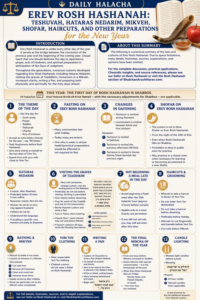
Introduction
Erev Rosh Hashanah is unlike every other day of the year. It serves as the bridge between the conclusion of the previous year and the beginning of the coming year. Chazal teach that one should dedicate this day to repentance, prayer, acts of kindness, and spiritual preparation in anticipation of the Days of Judgment.
Throughout the generations, numerous customs developed regarding Erev Rosh Hashanah, including Hataras Nedarim, visiting the graves of Tzaddikim, immersion in a Mikveh, increased charity, writing a Pan, and preparing both physically and spiritually for the holy days ahead.
About This Summary
The following is a practical summary of the laws and customs of Erev Rosh Hashanah. Due to space limitations, many details, footnotes, sources, explanations, and opinions have been omitted. For the complete discussion, practical applications, Chassidic insights, and source references, please see our Sefer on Rosh Hashanah or visit the Rosh Hashanah section of ShulchanAruchHarav.com.
- The Theme of the Day
- The night preceding Erev Rosh Hashanah was traditionally treated as the final night of preparation before the Days of Judgment. Chassidim would spend the night engaged in spiritual preparation, reflection, and prayer.
- One is to utilize Erev Rosh Hashanah for:
- Torah study
- Prayer
- Tehillim
- Teshuvah
- Charity
- Acts of kindness
- Many have the custom to accept an additional hiddur mitzvah for the coming year. When doing so, one should explicitly say “Bli Neder.”
- It is proper to seek forgiveness from others before Rosh Hashanah and not wait until Erev Yom Kippur.
- Those who regularly give charity daily should give extra Tzedakah on Erev Rosh Hashanah on behalf of the two days of Yom Tov.
- Spending time with wives: On Erev Rosh Hashanah, close to the entrance of the Holiday, the Rabbeim would spend some time speaking with their wives.
Fasting on Erev Rosh Hashanah
- Many communities have a custom to fast until midday on Erev Rosh Hashanah.
- Today many are lenient regarding this custom.
- One who is weak or fasting would impair his Yom Tov preparations is not required to fast.
Changes in Davening
- Tachanun is omitted during Shacharis of Erev Rosh Hashanah.
- Lamnatzeiach is omitted between Ashrei and Uva Letziyon.
However:
- Tachanun is recited in Selichos.
- Tachanun is recited the previous afternoon (28 Elul).
- Tachanun is recited in Kerias Shema Sheal Hamitah the previous night.
Shofar on Erev Rosh Hashanah
- The custom is not to blow Shofar on Erev Rosh Hashanah.
- This prohibition begins from the night of the 29th of Elul.
- This applies even when Rosh Hashanah falls on Shabbos.
- One may not blow Shofar publicly even for practice.
- However, one may practice in a closed room when necessary for learning purposes or to become accustomed to a new Shofar.
Hataras Nedarim
- The widespread custom is to perform Hataras Nedarim after Shacharis on Erev Rosh Hashanah.
- Ideally it should be performed before a panel of ten men, although three men suffice.
- The individual requesting the annulment remains standing while the Beis Din remains seated.
- Women generally do not perform Hataras Nedarim. However, a wife may appoint her husband to include her during his annulment.
- Children do not perform Hataras Nedarim.
- One should understand the language being recited.
- If one recalls a specific vow that was made, he should mention it privately to the Dayanim, as not all vows are eligible for annulment.
Visiting the Graves of Tzaddikim
- Many communities visit cemeteries on Erev Rosh Hashanah.
- The Chabad custom is to visit the resting places of the Rabbeim.
- One should preferably not eat before visiting a cemetery, although drinking is permitted and encouraged.
- One should distribute charity before praying at the gravesite.
- At the gravesite one prays to Hashem that his prayers be accepted in the merit of the Tzaddikim and may ask that the Tzaddik intercede on his behalf.
- Many recite Maaneh Lashon and write a Pan to be read at the Ohel.
- One should tuck in his Tzitzis upon entering the cemetery.
- One who is impure due to nocturnal emission [Keri], or any release of seed, may not visit a cemetery until he immerses in a Mikveh.
- One who has not visited a cemetery [in thirty days] is to recite the following blessing upon seeing it:
ברוך אתה יי אלקינו מלך העולם אשר יצר אתכם בדין וזן אתכם בדין וכלכל אתכם בדין והמית אתכם בדין ויודע מספר כלכם והוא עתיד להחיותכם ולקיים אתכם בדין: ברוך אתה יי מחייה המתים: [1]
After leaving:
- Wash hands three times alternately.
- Wash before entering a home.
- Many have the custom to throw grass or earth behind them.
Not Beginning a Meal Late in the Day
- As on Erev Shabbos, one should avoid beginning a fixed meal after the tenth halachic hour of the day, approximately three hours before sunset.
- This restriction applies only to a meal.
- Snacks remain permitted.
- If one did not yet eat, he may still eat even after this time.
Haircuts and Grooming
- It is a mitzvah to take a haircut on Erev Rosh Hashanah in honor of Yom Tov.
- One should not enter Yom Tov looking disheveled.
- A haircut should not be taken before Davening.
- Many are careful to take the haircut before midday.
- Likewise, it is a mitzvah to cut one’s fingernails and toenails before Yom Tov.
- The nails should be cut before Mikveh.
Bathing and Mikveh
- It is a mitzvah to bathe in hot water on Erev Rosh Hashanah.
- The longstanding custom is to immerse in a Mikveh.
One should:
- Cut nails first.
- Remove all Chatzitzos.
- Clean and comb the hair.
- Immerse three times.
- Ideally one immerses after midday.
- Some are particular not to dry the Mikveh water completely from their body.
Yom Tov Clothing
- One should wear respectable Yom Tov clothing.
- The Chabad custom is not to wear a Kittel on Rosh Hashanah.
Writing a Pan
- It is customary amongst Chassidim to write a Pan (Pidyon Nefesh) before Rosh Hashanah.
- The Pan is written on behalf of oneself and one’s family.
- The Pa”n is to be sent to be read at the Ohel or placed into a Sefer of the Rebbe.
- The custom is to write a Pa”n on a blank piece of paper without lines.
- Many immerse beforehand and wash their hands prior to writing it.
- One typically begins with:
- כ”ק אדמור”.
- “אנא לעורר רחמים רבים עלי…”
The Final Mincha of the Year
- From one hour before Mincha it is customary to increase in Tehillim.
- The Mincha of Erev Rosh Hashanah should be recited with special concentration as it is the final prayer of the outgoing year.
- When Erev Rosh Hashanah falls on Friday, Hodu and Patach Eliyahu are recited as usual.
Candle Lighting
- Women customarily light candles before sunset.
- The blessing recited is:
- “Lehadlik Ner Shel Shabbos Veshel Yom Hazikaron.”
- It is proper to prepare:
- A 24-hour candle.
- Yahrzeit candles when applicable.
Quick Reference Table
| Topic | Practical Law |
| Teshuvah | Increase Torah, Tehillim and repentance |
| New Hiddur | Accept with “Bli Neder” |
| Forgiveness | Request before Rosh Hashanah |
| Fast | Some Have Custom until midday |
| Tachanun | Omitted at Shacharis |
| Shofar | Not blown on Erev Rosh Hashanah |
| Hataras Nedarim | After Shacharis |
| Cemetery | Custom to visit Tzaddikim |
| Meal after 10th hour | Avoid beginning a fixed meal |
| Haircut | Mitzvah before Yom Tov |
| Nail cutting | Before Mikveh |
| Mikveh | Customary after midday |
| Pan | Custom of Chassidim |
| Final Mincha | Daven with extra concentration |
| Candle lighting | Before sunset |
Practical Examples
Example 1
A person forgot to perform Hataras Nedarim before noon. He may still perform it until the onset of Rosh Hashanah.
Example 2
Someone purchased a new Shofar and wishes to practice. He may practice only in a private indoor location.
Example 3
A person visits the Ohel in the morning. He should avoid eating beforehand and should wash his hands after leaving.
Example 4
A person forgot to eat before the tenth halachic hour. He may still eat a meal later.
Example 5
A woman forgot to light candles before sunset. She may light from an existing flame after Yom Tov begins.
Summary
Erev Rosh Hashanah is a day dedicated to spiritual and physical preparation for the Days of Judgment. Through Teshuvah, prayer, charity, Hataras Nedarim, Mikveh, visiting Tzaddikim, and proper Yom Tov preparation, one enters Rosh Hashanah with purity, dignity, and readiness to crown Hashem as King and receive a good and sweet year.
[1] The following additional Nussach is added in Maaneh Lashon:
אתה גיבור לעולם אדני, מחיה מתים אתה, רב להושיע מכלכל חיים בחסד מחיה מתים ברחמים רבים, סומך נופלים, ורופא חולים, ומתיר אסורים, ומקים אמונתו לישני עפר. מי כמוך בעל גבורות ומי דומה לך, מלך ממית ומחייה ומצמיח ישועה: ונאמן אתה להחיות מתים.