Introduction
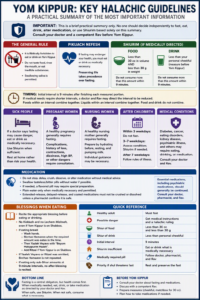
Fasting is one of the central obligations of Yom Kippur. Nevertheless, preserving life takes precedence, and a person for whom fasting may be dangerous is obligated to follow proper medical and halachic guidance. When medically sufficient, food or drink may be consumed in measured amounts known as Shiurim. When Shiurim are inadequate or unsafe, the patient must consume whatever is necessary. The laws of fasting for a sick, pregnant, nursing, or postpartum person are highly individual and may involve danger to life. The following is only a concise summary of the Halachos. A person with any medical concern should obtain current instructions from a qualified doctor and a competent Rav before Yom Kippur.
About This Summary
This is a brief practical summary only. Many qualifications, disagreements, medical considerations, exceptional cases, and source references have been omitted. No one should decide independently to fast, eat, drink, alter medication, or use Shiurim based solely on this summary. For the complete discussion and practical guidance, see our Sefer on Yom Kippur or visit the Yom Kippur section of ShulchanAruchHarav.com.
- The General Prohibition
- It is Biblically forbidden to consume even a small amount of food or drink on Yom Kippur. The larger measurements discussed below determine the liability of Kareis. They do not make smaller quantities ordinarily permissible.
- The measurements become practically relevant only when a sick person must eat or drink. When medically safe and halachically directed, the patient is given less than the applicable Shiur at regulated intervals.
It is also forbidden to:
- Taste food, even when intending to spit it out.
- Rinse the mouth, even with water.
- Eat inedible substances.
- Deliberately induce vomiting for relief.
Swallowing ordinary saliva is permitted.
- The Shiurim
Food: When a doctor and Rav direct a patient to eat in Shiurim:
- Eat less than 30 cc in volume.
- The portion should also weigh less than 30 grams.
- Do not consume more than this amount within nine minutes.
Food is measured by both volume and weight. A container holding 30 cc, approximately the size of a typical matchbox, may be prepared before Yom Kippur.
Drink: The liquid measurement is personal and is based on less than the amount that fills one cheek. Before Yom Kippur:
- Fill one cheek with water.
- Empty it into a measuring cup.
- Mark that amount.
- When Shiurim are medically permitted, drink less than the marked amount within each interval.
For an average adult, the full measurement is often approximately 42 cc, but the personal measurement should preferably be prepared beforehand.
- Timing
- The initial interval is nine minutes after finishing each measured portion of either food or liquid. If medical needs require shorter intervals, a doctor and Rav may direct the interval to be reduced.
- All foods eaten during an interval combine with one another, and all liquids consumed during an interval combine with one another. Food and drink do not combine with each other. Accordingly, when authorized, one may eat less than the food Shiur and drink less than the liquid Shiur during the same nine minute interval.
- Shiurim are not a general dispensation. A person medically required only to drink must continue abstaining from food.
- Sick People and Pikuach Nefesh
A person whose health may be endangered by fasting must eat or drink as medically necessary. Refusing required nourishment in a dangerous situation is not an act of righteousness.
Before Yom Kippur, a person with an illness or medical condition should ask the treating doctor:
- Whether fasting is medically safe.
- Whether complete rest (no Shul) would make fasting safe.
- Whether drinking alone is sufficient.
- Whether Shiurim are sufficient.
- What symptoms require stopping the fast.
- Whether regular eating or drinking may become necessary.
The medical information should then be presented to a competent Rav.
If a doctor familiar with the condition says that fasting may create danger, the patient must follow the medical and halachic directive. This includes danger that may develop later rather than immediately.
When Shiurim are sufficient, they should be used. If they are medically insufficient, the patient must eat or drink normally according to need.
As a practical priority, a person who can complete the fast only by resting at home should generally prioritize the fast over attending lengthy services, subject to personal medical and halachic guidance.
Conditions that often require doctor-directed leniencies:
- Cancer patients
- Eating disorders (anorexia or bulimia)
- Diabetes
- Kidney stones/renal disease
- Serious psychiatric illness
These individuals should discuss fasting plans with both their physician and Rav before Yom Kippur.
- Pregnant Women
- A healthy pregnant woman is generally obligated to fast. Pregnancy alone does not create an automatic permission to begin eating or drinking in Shiurim.
- However, any pregnancy involving medical complications, a history of pregnancy loss, concerning symptoms, abnormal blood pressure, significant dizziness, contractions, or another danger requires advance consultation with a doctor and Rav.
If the doctor determines that fasting may create danger, the woman must follow the individualized instructions given. Depending on the situation, this may involve:
- Resting throughout the fast.
- Drinking or eating in Shiurim.
- Shortening the intervals.
- Drinking or eating normally when necessary.
A medically dangerous craving, as defined by competent medical and halachic authorities, may likewise require eating. An ordinary food craving does not automatically qualify.
- Nursing Women
A healthy nursing mother is generally obligated to fast and should not automatically begin drinking Shiurim.
She should prepare by:
- Increasing fluids before the fast.
- Drinking generously on Erev Yom Kippur.
- Resting as much as possible.
- Arranging childcare assistance.
- Pumping and storing milk when practical.
- Discussing suitable alternatives for the infant when appropriate.
Individual guidance is necessary when:
- The infant is premature, ill, or medically fragile.
- The infant depends exclusively upon nursing.
- The infant refuses all alternatives.
- Milk production decreases significantly during the fast.
- The mother develops unusual weakness, dizziness, or concerning symptoms.
If drinking is authorized, nourishing liquids may be more useful than plain water. The particular beverage should be selected with the doctor and Rav.
- A Woman After Childbirth
The rules depend upon the number of halachic weekdays since the birth:
- Within Three Weekdays: She does not fast. She is to eat Shiurim unless she or her doctors feel she needs to eat more. Even if she wishes to fast, she should not do so contrary to the applicable ruling.
- More Than Three but Within Seven Weekdays: If she says that she must eat, or expresses no opinion, she is fed, generally using Shiurim when sufficient. If she says she does not need to eat, the case requires proper medical and halachic evaluation, without which she is to fast as usual.
- After Seven Weekdays: She is treated according to the ordinary laws governing illness. If illness or danger requires eating, she eats as directed.
- These periods according to calendar weekdays rather than exact 24-hour units.
- A woman after a qualifying miscarriage may have the same status as a woman after childbirth.
- Medication
Who may take medication? Medication may be taken if:
- A person is ill, bedridden, or feels weak throughout the body.
- Missing the medication could cause illness, deterioration, significant mental health symptoms, or medical complications.
- A doctor advises that skipping the medication may pose health risks.
Generally not permitted for minor discomforts alone (for example, a mild headache or minor pain) if the person is otherwise healthy and functioning normally.
How should medication be taken? Preferred order of options:
- Swallow with saliva only
- This is the preferred method.
- No water is used.
- If necessary, use bitter water
- A bitter pill may be dissolved or crushed before Yom Kippur (only if medically safe to do so).
- The resulting bitter liquid may be used to swallow the medication.
- Never crush or dissolve pills unless a pharmacist confirms it is safe. Extended-release and enteric-coated medications often must not be altered.
- Other bitter liquids
- Very bitter tea essence.
- Extremely salty water.
- Other preparations that make the liquid genuinely unpleasant to drink.
- Plain water
- Used only when medically necessary and when lack of medication could involve a danger to life or serious health risk.
Psychiatric medications:
- Antidepressants
- Anti-anxiety medications
- Bipolar medications
- Schizophrenia/psychosis medications
- Eating-disorder treatments
should generally not be skipped without consulting the prescribing physician.
Mental health deterioration can itself be considered a serious medical concern, and many psychiatric medications should be continued on Yom Kippur.
Birth-control (“mini-pill”): If a Rav and physician have approved use of the medication for physical, emotional, or mental health reasons:
- The pill may be taken on Yom Kippur if needed.
- Try to adjust timing before and after Yom Kippur if medically acceptable.
- If it must be taken during the fast, it should preferably be swallowed without water.
ADHD medication: Depends on the situation:
- If stopping the medication would cause severe instability or major dysfunction, it may be taken.
- If used primarily for improved concentration or performance, it generally should not be taken on Yom Kippur.
- Blessings When Eating
A person permitted or required to eat must recite the appropriate blessing before eating or drinking.
One does not recite Kiddush and does not require Lechem Mishneh, even if Yom Kippur falls on Shabbos.
If bread is eaten:
- Wash the hands normally for bread.
- Recite Birchas Hamazon when the required amount was eaten within the applicable time.
- Recite Yaaleh Veyavo with Beyom Hakippurim Hazeh.
- Add Ritzei when Yom Kippur falls on Shabbos.
If Yaaleh Veyavo or Ritzei was omitted, Birchas Hamazon is not repeated.
A person eating only sub-Shiur portions at nine-minute intervals generally does not recite an after-blessing.
Quick Reference
| Situation | Practical direction |
| Healthy adult | Must fast |
| Pregnant or nursing | Generally fast; individual medical concerns require consultation |
| Possible danger | Obtain medical instructions and a halachic ruling |
| Shiur of food | Less than 30 cc and less than 30 g |
| Shiur of drink | Less than the personally measured cheekful |
| Initial interval | Nine minutes |
| Shiurim insufficient | Consume what is medically necessary |
| Medically required pill | Follow doctor, pharmacist, and Rav |
| Kiddush when eating | Not recited |
| Lechem Mishneh | Not required |
| Ordinary blessings | Recited |
| Birchas Hamazon | Recited when the qualifying amount of bread was eaten |
| Priority if Shul threatens fast | Rest and preserve the fast |
Summary
Every amount of food or drink is ordinarily forbidden on Yom Kippur. At the same time, preserving life is itself a Torah obligation. A person with illness, pregnancy complications, nursing concerns, recent childbirth, or essential medication must obtain individualized medical and halachic instructions before the fast. When Shiurim are appropriate, the basic practical measurements in the supplied material are less than 30 cc and 30 grams of food, and less than one personal cheekful of liquid, initially separated by nine-minute intervals. These figures must never delay urgently needed care. If health requires more, the patient must eat or drink whatever is necessary.