A practical guide to the Chol Hamoed Sukkos prayers, including Yaaleh Veyavo, complete Hallel, Hoshanos, Musaf, Kerias Hatorah, and what to do if Yaaleh Veyavo was omitted.
Introduction
The prayers of Chol Hamoed Sukkos combine the structure of a weekday service with the additions unique to the festival. While the Shemoneh Esrei remains that of a regular weekday, special additions are inserted, including Yaaleh Veyavo, complete Hallel, Hoshanos, a special Torah reading, and Musaf.
Because many additional sections are recited, it is important to be familiar with the correct order of the service and with the practical laws that commonly arise, particularly regarding Yaaleh Veyavo.
Important Disclaimer
This is a practical summary of the primary laws and customs of Chol Hamoed Sukkos. Many details, exceptions, and sources have been omitted. For complete guidance in specific situations, consult the full chapter on shulchanauchharav.com.
The Order of Davening
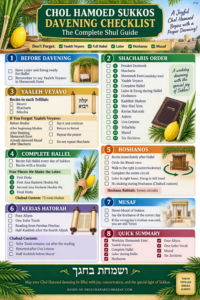
The order of Shacharis on Chol Hamoed Sukkos is as follows:
| Order | Prayer |
| 1 | Regular weekday Pesukei Dezimrah and Shacharis |
| 2 | Weekday Shemoneh Esrei with Yaaleh Veyavo |
| 3 | Complete Hallel |
| 4 | Lulav shaking during Hallel |
| 5 | Hoshanos |
| 6 | Kaddish Shalem |
| 7 | Shir Shel Yom |
| 8 | Kerias Hatorah |
| 9 | Ashrei |
| 10 | Uva Letzion |
| 11 | Yehallelu |
| 12 | Musaf |
Yaaleh Veyavo
- The weekday Shemoneh Esrei is recited for Maariv, Shacharis, and Mincha, with the addition of Yaaleh Veyavo.
- Unlike Rosh Chodesh Maariv, forgetting Yaaleh Veyavo on Chol Hamoed requires repetition of Shemoneh Esrei even at Maariv.
If You Forgot Yaaleh Veyavo
| When remembered | What to do |
| Before Modim | Insert it and continue |
| After beginning Modim | Return to Retzei |
| After finishing Shemoneh Esrei | Repeat the prayer |
| After Shacharis and already davened Musaf | Do not repeat Shacharis |
If You Are Unsure
If one is unsure whether he recited Yaaleh Veyavo, the practical ruling is to complete the prayer and repeat Shemoneh Esrei as a voluntary condition-based prayer (Tefilas Nedavah).
Complete Hallel Every Day
- Throughout all seven days of Sukkos, as well as Shemini Atzeres, the complete Hallel is recited with a blessing.
- This differs from Pesach, when only the first day receives a full Hallel and the remaining days receive a partial Hallel.
Chassidic Insight
Chassidus explains that the spiritual revelations of Sukkos are internally experienced each day of the festival. Therefore, each day contains a unique and complete level of joy that warrants the recitation of the complete Hallel throughout the entire Yom Tov.
Lulav During Hallel
- The Lulav is held throughout Hallel.
- The Chabad custom is to hold the Esrog only at the times of the actual shakings.
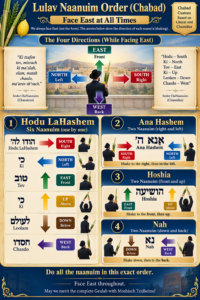
The Lulav is shaken at four places in Hallel:
- The first Hodu
- The first Ana Hashem Hoshia Na
- The repeated Ana Hashem Hoshia Na
- The final Hodu
According to Chabad custom, a total of 72 shakes are performed during Hallel.
Hoshanos
- Immediately following Hallel, Hoshanos are recited.
- One circles the Bimah once each day while holding the Lulav and Esrog and reciting that day’s Hoshana.
On Hoshana Rabbah, seven circuits are made.
Important details:
- The circuit is made to the right (counterclockwise).
- One should complete the entire circle and not take shortcuts.
- The Lulav remains in the right hand and the Esrog in the left.
- The Chabad custom is not to shake the Lulav during Hoshanos.
One Without a Lulav
One who does not possess a Lulav does not participate in the actual circuit around the Bimah.
Kerias Hatorah
- On Chol Hamoed Sukkos, four Aliyos are called to the Torah.
- Only one Torah scroll is removed, unlike Chol Hamoed Pesach when two Torah scrolls are used.
- The reading comes from Parshas Pinchas and describes the Korbanos of Sukkos.
Number of Aliyos
- Exactly four Aliyos are called on Chol Hamoed.
- Additional Aliyos are not added, unlike on many Shabbosim and Yomim Tovim.
- The reason is to avoid unnecessary delay to the congregation.
Kaddish
- The Half-Kaddish is recited only after all four Aliyos have concluded.
- If Kaddish was mistakenly recited after the third Aliyah, it should be repeated following the fourth Aliyah.
Returning the Sefer Torah
According to Chabad and many Sephardic communities, the Sefer Torah remains out after the Torah reading and is returned only following Uva Letzion, immediately before the Half-Kaddish that precedes Musaf.
Musaf
- The Musaf prayer follows the standard Musaf text of Sukkos.
- However, the section describing the Korban Musaf changes daily, corresponding to the unique sacrifices offered on each day of Sukkos.
- One who accidentally recited the wrong day’s Korban description nevertheless fulfills his obligation.
Six Remembrances
Following the completion of davening, it is customary to recite the Six Zechiros.
Practical Summary
| Topic | Bottom Line |
| Shemoneh Esrei | Weekday text with Yaaleh Veyavo |
| Forgot Yaaleh Veyavo | Usually repeat or return to Retzei depending on where remembered |
| Hallel | Complete Hallel every day |
| Lulav | Shaken during Hallel |
| Hoshanos | After Hallel |
| Torah reading | Four Aliyos |
| Torah scrolls | One Sefer Torah |
| Musaf | Special Musaf of Sukkos |
| Sefer Torah returned | After Uva Letzion (Chabad custom) |
| Six Zechiros | Recited after davening |